General Discussion
Related: Editorials & Other Articles, Issue Forums, Alliance Forums, Region ForumsI have posted this question in the Jewish group here but would like to ask here!
I am currently writing a book on religious themes in art and would like the Jewish perspective on the Biblical story of Jacob Wrestling with the Angel. Two artists of this scene provides the Protestant informed view of Rembrandt and the Catholic view of Delacroix.
Hopefully, someone here can enlighten me further.
I thank you in advance!
 = new reply since forum marked as read
Highlight:
NoneDon't highlight anything
5 newestHighlight 5 most recent replies
= new reply since forum marked as read
Highlight:
NoneDon't highlight anything
5 newestHighlight 5 most recent replies

mcar
(45,603 posts)
CTyankee
(67,747 posts)I do have Simon Schama's book "Rembrandt's Eyes" (over 500 pages!) which has some background. Schama is an absolute treasure on art and he is a keen observer. I would urge anyone who likes art history to get his books!
alphafemale
(18,497 posts)The three religions are linked tighter than a wet knot.
alphafemale
(18,497 posts)
MineralMan
(150,562 posts)And another from the same site:
https://www.chabad.org/parshah/article_cdo/aid/2778940/jewish/Jacob-Wrestles-with-Esaus-Angel.htm
One more:
https://crownheights.info/op-ed/411057/jews-and-art-and-he-wrestled-him-until-dawn/
And still another:
https://jewishsacredaging.com/wrestling-with-an-angel/
All came from a Google image search for jacob wrestling angel judaic art (no quotes)
Beastly Boy
(13,283 posts)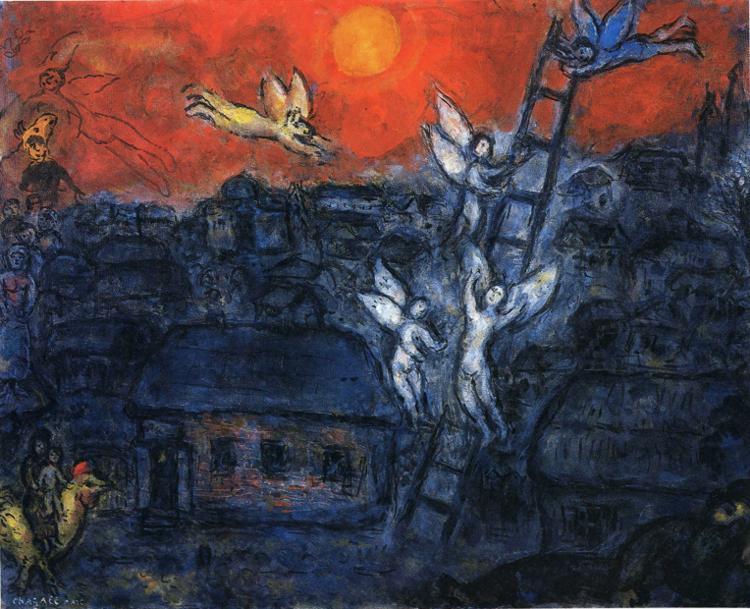
https://www.wikiart.org/en/marc-chagall/jacob-s-ladder-1973
He came back to the theme again and again, especially in his old age. Judging by the content of his paintings, the descent of the angel(s) to Earth is far more significant than the angel's struggle and loss to Jacob, which is one of the most central events depicted in the Torah. It is as if, to Chagall, the outcome of the contest is a given, but the angel's descent to Earth itself is what's most miraculous, making the Earth as miraculous as the Heaven.
Also worth noting is the agnostic view of the event painted by Paul Gauguin

The ladder, which, in most biblical interpretations, is a metaphorical pathway between the physical and the spiritual world, is completely absent from the picture. Gauguin depicts the event as a physical wrestling match.
Interestingly, neither example follows the mainstream traditional interpretations given by the Jewish biblical scholars.
CTyankee
(67,747 posts)in Paris.
I did know of the Gauguin. But I wondered how to fit it in. My book is about gesture and pose in art and how artists work a theme around gesture/poses. Of course contraposto is the most famous.
Beastly Boy
(13,283 posts)you are looking for signs in the movement, the poses and the gestures depicted in paintings of the Jacob's Ladder story that may signify some meaning in the context of Judaism.
If this is the case, and I am not sure whether I got it right, I am afraid painting and sculpture may not be the best sources for your work. Judaism, like Islam, is not big on depicting figures, especially human figures. Any visual representation of a human or an angel would be contrary to the Jewish tradition, regardless of whether the author is Jewish or not.
Jews are big on the written word, though. If you do a comparative study juxtaposing written accounts of the event from Jewish sources to the paintings of the same event, it might provide you with some promising material for the book.
CTyankee
(67,747 posts)Chagall, of course, was Jewish and his ceiling at the Garnier was about many of the performances there.
I am far from done with this book. I have more to explore and I just finished the other one that is now in the hands of my editor/designer. I plan to visit Paris next fall and see his magnificent ceiling in person. I am curating the art we will see both in Paris and in Barcelona. I have postponed this trip twice now because of the pandemic. Here's hoping next October will be better...