Welcome to DU!
The truly grassroots left-of-center political community where regular people, not algorithms, drive the discussions and set the standards.
Join the community:
Create a free account
Support DU (and get rid of ads!):
Become a Star Member
Latest Breaking News
Editorials & Other Articles
General Discussion
The DU Lounge
All Forums
Issue Forums
Culture Forums
Alliance Forums
Region Forums
Support Forums
Help & Search
General Discussion
Related: Editorials & Other Articles, Issue Forums, Alliance Forums, Region Forums
The Return of the Dixiecrat South

In the pre-1960s South, which Supreme Court Republicans have just brought back from the dead, Black citizens have no voice in federal lawmaking.
https://prospect.org/2026/06/03/return-of-dixiecrat-south-voting-rights-act-racial-gerrymandering/

It has been just one month since the 6-3 conservative majority on the Supreme Court effectively nullified Section 2 of the Voting Rights Act (VRA), making it lawful for states to draw congressional districts that systematically dilute the votes of Black and Latino Americans. Within hours, Southern states responded. Florida legislators passed a GOP gerrymander the day the decision was announced. Alabama moved to eliminate majority-minority districts even after primary-election votes had been cast, though an appellate court has temporarily blocked the state from proceeding. (UPDATE: The Supreme Court waved the gerrymandered map through last night.) In Tennessee, the district representing Memphis—majority-Black—was cracked into three, all now majority-white, all expected to turn red. By 2028, South Carolina will likely gerrymander out of existence the district that has elected the state’s only Black congressman, civil rights icon James Clyburn.
One certain consequence of Louisiana v. Callais is widely recognized: Millions of voters of color will no longer be able to elect a representative of their choice, while Republicans will lock down an even larger share of congressional seats. But what’s at stake is far bigger: whether voters of color can elect legislators whose votes actually reflect their policy preferences. We know this because we examined nearly 20 years of congressional votes and the survey responses of more than half a million Black, Latino, Asian American, and white voters who were asked if they supported high-profile congressional bills, ranging from the authorization of the war in Iraq to the Affordable Care Act to the early COVID response. What we found shows how much our democracy’s responsiveness has depended on the VRA—and how much will be lost without it.
As Memphis Goes, So Goes the South
Memphis bears witness to both the achievement and the reversal. For 19 years, one man has represented the majority-Black district encompassing Memphis. A progressive stalwart ranked the fifth most effective Democratic lawmaker in the House by the Center for Effective Lawmaking, he secured passage of the first formal congressional apology for slavery and brought home $69 million in community projects, including $3.15 million to restore the Historic Clayborn Temple—the organizing headquarters of the 1968 sanitation workers’ strike that brought Martin Luther King Jr. to Memphis for the last time. The name of this revered member of Congress? Steve Cohen, a white Jewish civil rights lawyer. Tennessee Republicans did not gerrymander Memphis to remove a Black legislator. They did it to disempower Black voters.
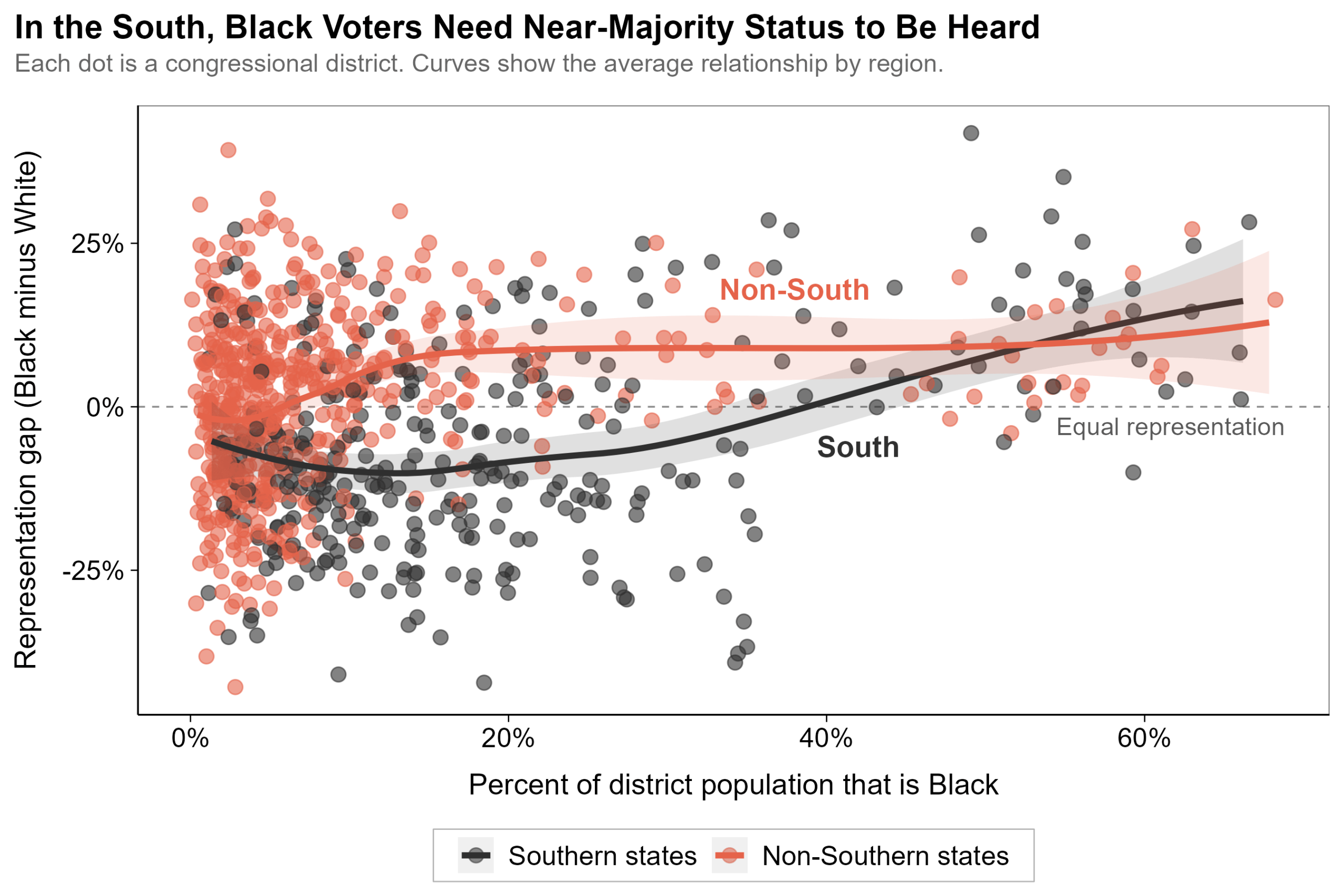
Callais will have similarly devastating consequences for the substantive representation of voters of color throughout the South. It will not only reduce the chance that they have champions like Steve Cohen in Congress; it will also increase the chance that policies they oppose become law and policies they support don’t. The figure below illustrates how representation in the House works today. Each dot represents a congressional district, with its position on the y-axis showing how well the average Black constituent is represented relative to the average white constituent in that same district. Values above zero mean Black Americans are better represented than white Americans; values below zero mean the opposite. The red and black curves trace the average relationship between this measure and the share of residents of each district who are Black, separately for non-Southern (red) and Southern (black) states.
snip
4 replies
 = new reply since forum marked as read
Highlight:
NoneDon't highlight anything
5 newestHighlight 5 most recent replies
= new reply since forum marked as read
Highlight:
NoneDon't highlight anything
5 newestHighlight 5 most recent replies
= new reply since forum marked as read
Highlight:
NoneDon't highlight anything
5 newestHighlight 5 most recent replies
The Return of the Dixiecrat South (Original Post)
Celerity
3 hrs ago
OP

erronis
(24,649 posts)1. And the "poor whites" won't have any say either. "Poor"" meaning less than $1M in wealth.

every Democrat from the Bayou to the Appalachains should be to get the poor white and the black vote to realize they are suffering from the same problems, and that they should blame the same people.

Solly Mack
(97,321 posts)2. ...

leftstreet
(41,312 posts)4. DURec