
Nearly half of US honeybee colonies died last year. Struggling beekeepers stabilize population
Source: AP
By SETH BORENSTEIN 2 hours ago
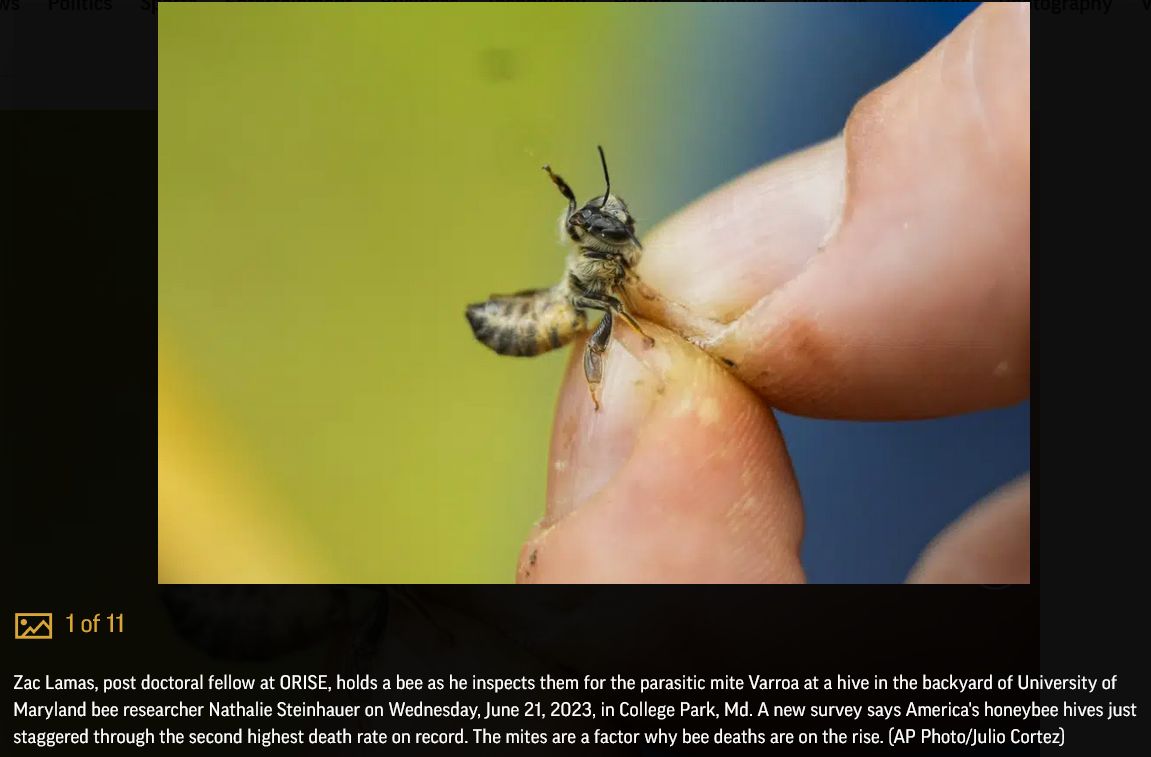
WASHINGTON (AP) — America’s honeybee hives just staggered through the second highest death rate on record, with beekeepers losing nearly half of their managed colonies, an annual bee survey found.
But using costly and Herculean measures to create new colonies, beekeepers are somehow keeping afloat. Thursday’s University of Maryland and Auburn University survey found that even though 48% of colonies were lost in the year that ended April 1, the number of United States honeybee colonies “remained relatively stable.”
Honeybees are crucial to the food supply, pollinating more than 100 of the crops we eat, including nuts, vegetables, berries, citrus and melons. Scientists said a combination of parasites, pesticides, starvation and climate change keep causing large die-offs.
Last year’s 48% annual loss is up from the previous year’s loss of 39% and the 12-year average of 39.6%, but it’s not as high as 2020-2021’s 50.8% mortality rate, the survey found. Beekeepers told the surveying scientists that 21% loss over the winter is acceptable and more than three-fifths of beekeepers surveyed said their losses were higher than that.
Read more: https://apnews.com/article/honeybees-pollinator-extinct-disease-death-climate-change-f60297706e19c7346ff1881587b5aced
 = new reply since forum marked as read
Highlight:
NoneDon't highlight anything
5 newestHighlight 5 most recent replies
= new reply since forum marked as read
Highlight:
NoneDon't highlight anything
5 newestHighlight 5 most recent replies

cilla4progress
(26,497 posts)Sickening.

Marthe48
(22,752 posts)Have seen some but not many in the clover in my yard. My lawn hadn't been mowed since the end of May because of the dry weather, just got mowed today, so I hope many bees got to harvest the unsprayed growth in the yard.

BarbD
(1,372 posts)I spoke to 12 years ago. RoundUp is still around. This is all soooooo stupid.

peppertree
(23,136 posts)By triggering the collapse of pollinators, for long enough, we might just become dependent on whatever GMO garbage Monsatan sees fit to sell us.

Martin68
(27,123 posts)Farmers need to develop more environmentally beneficial practices such as integrated pest management (IPM).
Integrated Pest Management (IPM) is an effective and environmentally sensitive approach to pest management that relies on a combination of common-sense practices. IPM programs use current, comprehensive information on the life cycles of pests and their interaction with the environment. This information, in combination with available pest control methods, is used to manage pest damage by the most economical means, and with the least possible hazard to people, property, and the environment.
The IPM approach can be applied to both agricultural and non-agricultural settings, such as the home, garden, and workplace. IPM takes advantage of all appropriate pest management options including, but not limited to, the judicious use of pesticides. In contrast, organic food production applies many of the same concepts as IPM but limits the use of pesticides to those that are produced from natural sources, as opposed to synthetic chemicals.
https://www.epa.gov/safepestcontrol/integrated-pest-management-ipm-principles

bronxiteforever
(11,122 posts)
Oopsie Daisy
(6,670 posts)
FailureToCommunicate
(14,583 posts)got all the equipment, the boxes and outfits, and the colony.
Alas, his hive was among those that didn't make it thru last summer.
Very sad, but he vows to try again.

Oopsie Daisy
(6,670 posts)FailureToCommunicate
(14,583 posts)-can't remember the name of the blight- so there is some hope for a next time.
Oopsie Daisy
(6,670 posts)TeamProg
(6,630 posts)their seed.
Strong statement, I know... I should have said "probably".

Chakaconcarne
(2,772 posts)
hibbing
(10,531 posts)Converting my backyard to native plants and grasses to help native bees, which honeybees are not. I am not saying honeybees are bad btw.
Peace

getagrip_already
(17,802 posts)The article is a bit of hyperbole, but the basic facts are correct.
Beekeepers lose colonies for a lot of reasons, including their own lack of skill. You can both lose colonies and end up with more than you started with. Or give up and go bust.
But honeybees are remarkable creatures, and one of their racial drives is to reproduce and build new colonies. So beekeepers are keeping up, in spite of themselves.
Honeybees are not an endangered species, but pollinators are.
In any case, they face a lot of threats. Varoa mites are a huge threat, followed by beekeeper error, pesticides, issues with queen health, weather, climate change, disease, and predation.
But it isn't sensational. It is managed chaos.

clementine613
(561 posts)It's almost like they don't care if the food chain falls apart and everyone and everything dies.

MayReasonRule
(4,019 posts)They have 40 acres outside of town
We have a 1/4 acre at our home.
So far so good!!
Buzz, buzz, buzz!
It's always a challenge, and they're constantly learning and implementing improvements as they do.
They just recently harvested their first honey, it's scrumptious!!
onetexan
(13,913 posts)Beautiful budding blooms. This year i barely saw any & wondered why. 😕

LT Barclay
(3,173 posts)But >90% of our pesticide use is neo-nics. So farmers and pesticide companies will wait for a collapse before they're willing to change.

Farmer-Rick
(12,494 posts)It gets into streams and rivers, causing more destruction.
This is how they kill bees and other pollinators: "Because they are systemic chemicals absorbed into the plant, neonicotinoids can be present in pollen and nectar, making them toxic to pollinators that feed on them. The potentially long-lasting presence of neonicotinoids in plants makes it possible for these chemicals to harm pollinators even when the initial application is made months before the bloom period."
https://xerces.org/pesticides/understanding-neonicotinoids
But capitalism and deregulation always wins out in the US.
LT Barclay
(3,173 posts)I’m also wondering if they are a factor in so many people acting crazy. My hypothesis is that they attach to the same receptors in the brain that nicotine does, but they don’t stimulate the release of dopamine and serotonin so people are agitated like a smoker going cold turkey.

CRK7376
(2,227 posts)This is my thrid year trying to raise honey bees and harvest honey. No success my first two years and last year looked great but by late fall the bees were dead or gone elsewhere. So far this year is going really well for this first timer.......my mentor has been raising bees over 60 years and he's having some difficulty this year too.
Response to Omaha Steve (Original post)
CRK7376 This message was self-deleted by its author.

Kaleva
(40,225 posts)in my yard and gardens
There are 14 type of native bees in Michigan.


JCMach1
(29,100 posts)Thanks Monsanto
Martin68
(27,123 posts)plants. Imported honey bees are in direct competition with native bee populations. Both populations are equally threatened by the overuse of pesticides.

MissB
(16,341 posts)I feel better starting all my flowers from seeds. I don’t know if it makes a difference, but I’m committed. I haven’t bought anything this year.
My petunias are slow to start but they’re getting there and some of them have to a of blooms. Soon my tithonia will be swarming with bees. They’ve already been all over my deutzia tree (which came with the house, so I take zero credit there).
We leave the dandelions in the spring. Soon after the bees are all over the plum tree, then the purples (perennial geranium, columbine, etc). I used to buy tons of bedding plants each year but now I simply grow them from seed. It’s kinda nice to have unusual petunias, cosmos, marigolds and coleus etc.
Maybe when I retire I’ll get into bee keeping. I just can’t yet.