Economy
Related: About this forumSTOCK MARKET WATCH, Thursday, December 15, 2011
Last edited Thu Dec 15, 2011, 03:07 PM - Edit history (7)
[font size=3]STOCK MARKET WATCH, Thursday, December 16, 2011[/font]
AT THE CLOSING BELL ON December 15, 2011
[font color=red]
Dow Jones 11,823.48 -131.46 (-1.10%)
S&P 500 1,211.82 -13.91 (-1.13%)
Nasdaq 2,539.31 -39.96 (-1.55%)
10 Year 1.90% -0.05 (-2.56%)
30 Year 2.90% -0.08 (-2.68%)
[/font]
[HR width=85%]
[font size=2]Market Conditions During Trading Hours[/font]
[center]


[/center]
[font size=2]Euro, Yen, Loonie, Silver and Gold
[center]


[/center]
[center]

[HR width=95%]
[font color=black][font size=2]Handy Links - Market Data and News:[/font][/font]
[center]
Economic Calendar
Marketwatch Data
Bloomberg Economic News
Yahoo Finance
Google Finance
Bank Tracker
Credit Union Tracker
Daily Job Cuts
[/center]
[font color=black][font size=2]Handy Links - Economic Blogs:[/font][/font]
[center]
The Big Picture
Financial Sense
Calculated Risk
Naked Capitalism
Credit Writedowns
Brad DeLong
Bonddad
Atrios
goldmansachs666
The Stand-Up Economist
[/center]
[font color=black][font size=2]Handy Links - Government Issues:[/font][/font]
[center]
LegitGov
Open Government
Earmark Database
USA spending.gov
[/center][font color=black][font size=2]Handy Links - Videos:[/font][/font]
[center]
Charlie Rose talks with Roubini
Charlie Rose talks with Krugman
William Black: This Economic Disaster
Bill Moyers with Kevin Drum and David Corn
[/center]
[div]
Financial Sector Officials Convicted since 1/20/09 = [/font][font color=red]12[/font]
[HR width=95%]
[center]

[/center]
[HR width=95%]
[font size=3][font color=red]This thread contains opinions and observations. Individuals may post their experiences, inferences and opinions on this thread. However, it should not be construed as advice. It is unethical (and probably illegal) for financial recommendations to be given here.[/font][/font]
 = new reply since forum marked as read
Highlight:
NoneDon't highlight anything
5 newestHighlight 5 most recent replies
= new reply since forum marked as read
Highlight:
NoneDon't highlight anything
5 newestHighlight 5 most recent replies

Hugin
(38,035 posts)DU3 has some problems with the link tag.
It's always been touchy about white-space, too.
Ready for tomorrow, but, does anyone have a cartoon? PBD?

Warpy
(114,723 posts)I'm a late riser on the wrong side of the country, so unless I could post the night before, there was no way I could do it.
Here's a goody:
Actually, we've been discussing moving to that chronology. Makes sense because market news is 24/7 and my stint here is by necessity a temporary situation. Mull it over and let me know. 
Thanks for the comic.
Ghost Dog
(16,881 posts)... Convenient timing for many, especially if you reckon each rolling market day begins in the Western Pacific...

Nb. I'd wondered whether or not, if the SMW itself wouldn't be well-accepted in LBN, we could at least post a stub there each day, quoting the previous day's closing numbers and pointing to the daily thread here.
Hugin
(38,035 posts)Give it a shot.
Aside: TG forwarded a link to me she thinks may be of particular interest to you. I'll post later due to cut/paste being next to impossible on this handheld.
Ghost Dog
(16,881 posts)could usefully be added to the OP above?



(Charts made freely available by Kitco).
- Looks like quite lemming-like behavior into and out of USD at times...
Hugin
(38,035 posts)But, if you think it's good... Go for it, we're in full discovery mode.
My suggestion would be to open two browser tabs; One in LBN and another on the SMW. You could add that suggestion to the xpost. 
I may mention to teh management we need another Fourm to take the place of the former E & O in DU2. It provided an area currently lacking in DU3. Maybe, that was the intent of "Good Reads". Poor grammar aside, it's not turning into the focused catch-all that was the E & O. I'm still unclear on if DU3 is planned to be Group centered instead of Forum centered.
Hugin
(38,035 posts)Last edited Thu Dec 15, 2011, 03:14 PM - Edit history (1)
If anyone is interested.
* The link tags that do not start with www need to have a http:// in front of them.
* Some links (Especially, those with lots of random characters in them i.e. youtube ) do not work at all.
* Don' tutch the white-spaces!
And, FOR GAWD'S SAKES IS THERE NO WAY TO TURN OFF WORD-WRAP IN THESE MESSAGE BOXES!!ii(eleven)1i!

tclambert
(11,198 posts)Sorry I can't post much in December. Just too busy. (I work for Santa, if you didn't know.)

nc4bo
(17,651 posts)Thanks Hugin.
I sincerely hope SMW threads find their way back to LBN.
Hugin
(38,035 posts)Perhaps, we'll fight that battle when the dust has settled a little.

Fuddnik
(8,846 posts)Well, that bites!
Hugin
(38,035 posts) 
Mud


mbperrin
(7,672 posts)post, but I wouldn't miss a day reading!

From the early morning crowd.
Thanks to everyone who helps make the SMW the SMW!
A bit of reality in today's crazy world really helps.
hamerfan
Ghost Dog
(16,881 posts)Eurozone sentiment continues to languish today, as the market’s dissatisfaction about EU summit conclusions festers, and investors brace for the possibility of France losing its AAA credit rating. Thus far there have been no advanced warnings of if or when the sovereign downgrade might precipitate, but there is increasing rhetoric from French policymakers that appears to be conditioning the market for such a scenario in the near future. EURUSD currently trading around 1.3000 having dipped to a low of 1.2945 yesterday, and Asian equity markets have had an extremely negative day; the Nikkei is -1.7%, Hang Seng -2.1%, and Shanghai Composite -2.1%.
The Norges bank shocked the market yesterday by cutting interest rates by 50bp to 1.75%. Going into the announcement, the consensus expectation was for a cut of only 25bp – with a minority of analysts looking for no change in rates at all. The actual outcome was therefore much more dovish than anyone had predicted, and demonstrates just how anxious the central bank is to pre-empt a downturn in the new year.
Coming up in today’s session, the headline event is undoubtedly the latest SNB meeting. Swiss interest rates are already set at rock-bottom 0.00%, so it is not anticipated that any action will be taken on the rates side of their monetary policy. However, there has been long speculation that the central bank may take this opportunity to raise the EURCHF exchange rate floor from 1.2000 to 1.2500 or perhaps even 1.3000. There are rumoured to be a number of hedge funds betting on such an announcement so expect a lot of volatility around the time of the release. Given the recent collapse in EURUSD and EUR-crosses, the main risk is that the SNB does not formally raise the EURCHF floor – an outcome that would likely lead to significant EURCHF selling as speculative longs liquidate.
Other key releases scheduled for release today include Eurozone PMI surveys and CPI for November, UK retail sales, US PPI, jobless claims, and industrial production figures.
/... http://www.fxstreet.com/fundamental/market-view/market-session-snapshot/2011/12/15/
Ghost Dog
(16,881 posts)FXstreet.com (Barcelona) - The SNB meeting revealed an unchanged key interest rate at 0% in December for the third consecutive month. The SNB also clarifies that the 1.20 floor remains the main focus to defend: “Even at the current rate, the Swiss franc is still high and should continue to weaken over time. The SNB stands ready to take further measures at any time if the economic outlook and the risk of deflation so require”, according to the publication.
At the moment of writing, the EUR/CHF is quoting at 1.2268 after losing more than 100 pips. Current daily low is positioned at 1.2255. Downside pressure remains.
/... http://www.fxstreet.com/news/forex-news/article.aspx?storyid=0053fe02-2c48-41b6-83a1-1d97f6c19931
Ghost Dog
(16,881 posts)(Reuters) - The decline in the euro zone's private sector eased a little this month, but a recession still looks inevitable with the region's periphery struggling badly, a key business survey showed on Thursday.
Markit's Eurozone Composite Purchasing Managers' Index (PMI), which measures the activity of thousands of euro zone companies, rose for a second month in December to 47.9 from 47.0, confounding expectations for a fall to 46.5.
But the preliminary reading lingered well below the 50 mark that divides growth and contraction for a fourth month.
Survey compiler Markit said France and Germany were responsible for the improved headline figure, while debt-laden peripheral countries remained firmly in contraction territory...
... Williamson pointed to steep falls in incoming new orders and very low levels of confidence about the year ahead in the services industry as reasons to expect more decline...
/... http://uk.reuters.com/article/2011/12/15/uk-eurozone-pmi-idUKTRE7BE0KG20111215
Ghost Dog
(16,881 posts)The Tankan survey for December shows that industrial sentiment has improved substantially compared with September. The overall business conditions index gained 4 points, but remained in negative territory (-7). However, enterprises have become gloomier about the economic climate for the next three months as the forecast index worsened to -13.
The details reveal some interesting trends. The improvement in actual conditions is only due to non-manufacturing sector, as daily life has returned to almost normal after the Great East Japan Earthquake. The business conditions index gained 5 points.
By contrast, business conditions in the manufacturing sector have not changed on average. For large enterprises in the manufacturing sector, they have seriously deteriorated. This sector is the first to feel the impact of slower international trade and the appreciation of the yen. Conversely, conditions for medium-sized have remained unchanged and those for small manufacturing enterprises have even improved. As they are often subcontractors for the large enterprises, they are likely to experience a fall in demand in the coming months. Indeed, they are anticipating a substantial deterioration of business conditions, their forecast index losing 7 points for medium-sized enterprises and 9 points for small enterprises.
A similar dichotomy between the manufacturing and nonmanufacturing can be seen in sales expectations for the current financial year. In particular, large manufacturers have scaled down their anticipations, whereas in the non-manufacturing sector they have actually improved. The decline in profits in the first half of the current financial year (April-September) was less than companies had anticipated. However, enterprises both in manufacturing and nonmanufacturing have scaled down their profit expectations for the second half of the year (October-March).
/... http://www.fxstreet.com/fundamental/economic-indicators/ecoflash/2011/12/15/

Pale Blue Dot
(16,834 posts)Dec 15 08:30 Initial Claims 12/10 390K 390K 381K
Dec 15 08:30 Continuing Claims 12/03 3650K 3650K 3583K
Dec 15 08:30 PPI Nov 0.1% 0.1% -0.3%
Dec 15 08:30 Core PPI Nov 0.0% 0.1% 0.0%
Dec 15 08:30 Empire Manufacturing Dec 3.0 3.0 0.61
Dec 15 08:30 Current Account Balance Q3 -$111.0B -$110.0B -$118.0B
Dec 15 09:00 Net Long-Term TIC Flows Oct NA NA $68.6B
Dec 15 09:15 Industrial Production Nov -0.1% 0.2% 0.7%
Dec 15 09:15 Capacity Utilization Nov 77.7% 77.8% 77.8%
Dec 15 10:00 Philadelphia Fed Dec 4.0 4.5 3.60
Read more: http://www.briefing.com/investor/calendars/economic/2011/12/12-16/#ixzz1gbSrj2dr
Hugin
(38,035 posts)
Ghost Dog
(16,881 posts)... Stocks rallied earlier after data on jobless claims and manufacturing signaled a strengthening U.S. economy and Spain sold almost twice as much debt as targeted at an auction. Labor Department figures showed initial jobless claims fell by 19,000 to 366,000 last week, the fewest since May 2008. The median of 47 economists had projected 390,000, according to a Bloomberg News survey.
Two reports showed manufacturing in the New York and Philadelphia regions expanded more than forecast in December. The Federal Reserve Bank of New York’s general economic index accelerated to the highest level in seven months, to 9.5 from 0.6 in November. Readings higher than zero signal expansion among companies in region, which covers New York, northern New Jersey and southern Connecticut.
The Federal Reserve Bank of Philadelphia’s general economic index increased to 10.3 in December from 3.6 last month, indicating expansion in the area covering eastern Pennsylvania, southern New Jersey and Delaware.
“Investors are trying to get a sense of not only how the economy is performing but also looking at what happens with policy, what happens in Europe,” Kevin Caron, a market strategist in Florham Park, New Jersey, at Stifel Nicolaus & Co., said in a telephone interview. His firm has about $108 billion in client assets. “You still have some lingering concerns about Europe’s financial crisis. As the market tries to digest all this, it’s looking at squaring valuations with all this new information.”
/... http://www.businessweek.com/news/2011-12-15/u-s-stocks-gain-as-data-signal-strengthening-american-economy.html
Be careful with (or avoid) the link to Business Week at present. My firewall says it blocked some potentially malicious content at the site.
Pale Blue Dot
(16,834 posts)SINGAPORE – Oil prices rose to near $96 a barrel Thursday in Asia after plunging the previous session on investor pessimism that Europe's debt crisis will trigger a recession on the continent next year.
Benchmark crude for January delivery was up 95 cents to $95.90 a barrel in late afternoon Singapore time in electronic trading on the New York Mercantile Exchange. The contract fell $5.19, or 5.2 percent, to settle at $94.95 on Wednesday.
In London, Brent crude was up 99 cents at $105.24 on the ICE futures exchange.
Crude dropped Wednesday amid growing concerns about slowing global oil demand. The International Energy Agency and the Organization of Petroleum Exporting Countries have recently forecast fuel consumption will grow slightly next year, but some analysts say even those modest expectations may be too optimistic.
http://old.news.yahoo.com/s/ap/oil_prices
Demeter
(85,373 posts)Oil advanced from a five-week low in New York as investors speculated that yesterday’s drop, the biggest since September, was exaggerated...
Pale Blue Dot
(16,834 posts)U.S. stock futures rose, indicating the Standard & Poor’s 500 Index (SPX) will snap a three-day slide, as investors awaited reports that may show manufacturing in the New York and Philadelphia regions expanded at a faster pace.
BioSante Pharmaceuticals Inc. (BPAX), the developer of hormone- replacement products, plunged 76 percent in early New York trading as its LibiGel compound failed to work in two large studies. Freeport-McMoRan Copper & Gold Inc. (FCX), the biggest publicly traded copper producer, fell 1 percent.
Futures on the S&P 500 expiring in March gained 0.4 percent to 1,211.1 at 10:34 a.m. in London. Dow Jones Industrial Average Index futures expiring the same month added 39 points, or 0.3 percent, to 11,801.
“Today’s a very important day in terms of data,” said John Plassard, director at Louis Capital Markets in Geneva. “Investors will carefully monitor two important numbers: the new jobless claims and the Fed’s manufacturing data. Americans know better than anyone else that confidence is the engine of growth. Good results today could help restore some of the much- needed confidence.”
http://www.bloomberg.com/news/2011-12-15/u-s-stock-futures-rise-before-new-york-philadelphia-manufacturing-data.html

xchrom
(108,903 posts)
Hugin
(38,035 posts)But, the quality of the SMW lies in posters such as yourself.
xchrom
(108,903 posts)
xchrom
(108,903 posts)Record robusta harvests in Vietnam and Brazil and potentially the biggest jump in Indonesian output in 16 years are boosting supplies of the coffee used in instant drinks and espressos as slowing economic growth threatens demand.
Production may climb for a fourth year, gaining 2.3 percent to 55.98 million bags (3.36 million metric tons) in 2011-2012, Rabobank International predicts. More supply will create the biggest glut in at least four years, according to Macquarie Group Ltd. Prices that already fell 9 percent this year will drop a further 8.3 percent to $1,750 a ton by June 30, the lowest level since October 2010, the median estimate in a Bloomberg survey of 13 traders showed.
Robusta surged 62 percent in London trading in 2010 as record demand created the first shortages in at least three years, according to Macquarie. Supply is now expanding amid mounting concern that Europe’s debt crisis will derail the global economy. Coffee sales fell for the first time in seven years in 2009 as nations contended with recessions, according to Euromonitor International Ltd., a London-based research group.
“We have record world production and I’m not optimistic on demand,” said Judith Ganes-Chase, a former Merrill Lynch & Co. analyst who is now the president of Katonah, New York-based J. Ganes Consulting LLC. “We’ll probably need to say goodbye to the bull market for a while.”

dixiegrrrrl
(60,181 posts)Assuming the markets really do respond to the good ole supply/demand function.

DemReadingDU
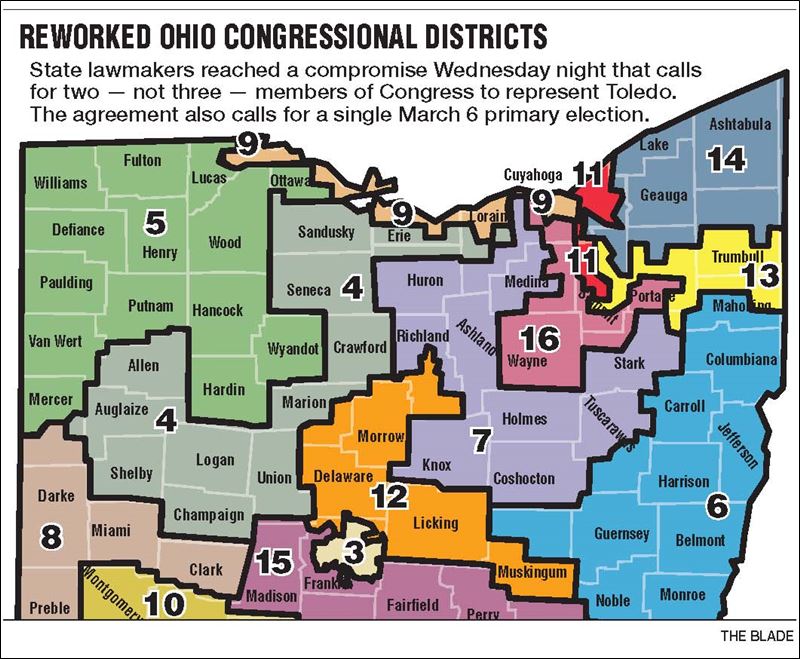
(16,002 posts)12/15/11 New U.S. House districts created
http://www.daytondailynews.com/news/politics/new-u-s-house-districts-created-ohioans-to-have-1-primary-1299350.html

We are in Clark County. This district was previously Hobson's, but he retired. Then the voters selected Steve Austria.
When Ohio was deemed to lose 2 Congressional seats, the map drawers couldn't decide if Clark County would be moved to Mike Turner in Montgomery County and a run-off with Austria.
Or another option was to combine Clark County with Steve Stivers district to the east of us.
Finally, Clark County was moved to Boehner's District. This will make it easy to protest him next year for the elections though.
The other district being re-drawn was Kucinich and Kaptur. Not sure how that was re-drawn yet.
edit to add
12/15/11
The revised 9th District would still stretch along the Lake Erie shoreline from Toledo to Cleveland and would still presumably set up a Democratic primary election contest between Miss Kaptur and U.S. Rep. Dennis Kucinich. The changes, however, are believed to be more favorable to Miss Kaptur than Mr. Kucinich.
more...
http://www.toledoblade.com/Politics/2011/12/15/Redrawn-map-puts-Toledo-in-2-districts-instead-of-3.html
amandabeech
(9,893 posts)I can't decide which district he would like best. There are so many choices!
Personally, I think that the 1st, 9th and 11th are really words of art.
DemReadingDU
(16,002 posts)An early version had the most gerrymandered map-drawing I had ever seen. Every county was cut-up, sliced and diced. Ohio was was totally un-recognizable.
xchrom
(108,903 posts)In 1999, when the Irish government adopted the euro, most Irish economists disagreed with the decision. It was made partly to reduce the country’s trade dependence on the U.K. But to use currency policy to achieve this was to place the cart before the horse.
Ireland’s business cycle is out of sync with the euro zone. It has an Atlantic economy: The U.K. remains the major export destination for Irish-owned companies, while the U.S. is the source of most incoming investments. A fiscal policy harmonized within the euro area will not synchronize the Irish business cycle with that of the French-German core.
In the U.S., any such lack of synchronicity among regions is addressed by the enormous federal budget. For every $1 worth of shock to a region’s income relative to the U.S. average, the budget provides 30 to 40 cents through reduced federal taxation and increased regional spending.
Such fiscal federalism is necessary for a monetary union to function effectively. The European Union deal announced last week studiously ignores this need. But at some point it must come onto the agenda, or further crises are guaranteed.
xchrom
(108,903 posts)Hungarian Prime Minister Viktor Orban is aiming for a “total takeover” of the central bank through proposals that would infringe on its independence, Magyar Nemzeti Bank President Andras Simor said.
The European Central Bank said it’s concerned about a bill to change the composition of the central bank’s decision-making bodies. A second proposal to merge it with the nation’s financial regulator is “only an option” and approval at a vote in Parliament tomorrow wouldn’t automatically create the combination, Orban said today in Budapest.
The premier has been curbing the power of independent institutions and asserting his influence since winning a two- thirds parliamentary majority last year. Simor said in March he rejected what he called “bullying” by a government official to quit before his mandate expires in 2013.
“This is undermining someone who had strong credibility among investors,” Benoit Anne, the London-based head of emerging-markets strategy at Societe Generale SA, said yesterday in a phone interview. “Demoting Simor would be a major blow to investor confidence. This is a major development.”
xchrom
(108,903 posts)U.K. retail sales fell more than economists forecast in November as cash-strapped households shunned a second month of price discounts and chose to save rather than spend amid warnings of a looming recession.
Sales including fuel fell 0.4 percent from October, the Office for National Statistics said today in London. The median forecast of 23 economists in a Bloomberg survey was for a 0.3 percent decline. Excluding auto fuel, retail sales fell 0.7 percent on the month.
The figures underline the pressure being felt by consumers as wages fail to keep pace with inflation and concern mounts that the economy is following the crisis-stricken euro region into recession. Unemployment hit a 17-year high of 2.64 million in the three months through October and is forecast to rise further next year.
“All in all, the picture for U.K. household consumption is not very encouraging,” said Annalisa Piazza, an economist at Newedge Group in London. “The labor market is extremely weak. Average earnings run at less than half the speed of inflation and consumer confidence hit record-low levels. We expect fourth- quarter household consumption to be a drag for GDP growth.”
xchrom
(108,903 posts)Tensions between London and Paris were heightened further on Thursday after the head of France's central bank suggested that the UK was a candidate for a credit rating downgrade.
France is bracing itself for the potential loss of its coveted AAA rating after two credit agencies last week indicated they were considering marking down countries in the eurozone.
But Bank of France governor Christian Noyer said they should instead be looking at the UK because of the scale of debt and inflation and the poor levels of growth and bank lending on this side of the Channel.
His comments came a day after French president Nicolas Sarkozy was quoted as branding David Cameron an "obstinate kid" for refusing to sign up to a treaty to rescue the euro last week.
xchrom
(108,903 posts)Manufacturing may contract this month from China to the euro region as global demand slows and Europe’s leaders struggle to contain the worsening debt crisis.
Chinese factory output may decline for a second month in December as Europe’s fiscal woes weigh on exports and home sales slide, preliminary results from a Markit Economics survey indicate. In the euro area, manufacturers may face a fifth straight month of contraction as the region endures its worst quarter for 2 1/2 years, a separate report showed.
Ripples from Europe’s debt turmoil have dented confidence among companies and consumers and hit global demand. The Organization for Economic Cooperation and Development said last month that trade in goods stalled in most major economies in the third quarter and it cut its growth forecast. The slowdown is spilling over into unemployment, with Nokia Siemens Networks announcing last month that it plans to eliminate 17,000 jobs worldwide.
“The near-term outlook is still bleak” in Europe, said Stella Wang, an economist at Nomura International Plc in London. “With the uncertainty about the sovereign debt crisis and slowing momentum of the euro area’s main trading partners, both businesses and consumers look set to continue holding back their investment and consumption decisions going into 2012.”
xchrom
(108,903 posts)Duke Buchan III’s $1 billion hedge fund beat U.S. stocks by 46 percent in the decade through March, a period that included the steepest equity-market losses since the 1930s.
Then came the selloff in August when global stocks suffered their worst nine-day drop since the 2008 financial crisis. For four days, The Dow Jones Industrial Average (INDU) alternated between gains and losses of more than 400 points, the longest streak ever, and its intraday swings have averaged twice the level seen during the first seven months of the year. Last week, Buchan told clients he is shutting his firm Hunter Global Investors LP.
“Markets seem to be driven more by the latest news out of Europe than by a company’s earnings prospects,” Buchan, 48, said in a Dec. 8 investor letter. “We have not weathered the ensuing volatility well.”
Traders who used to profit from price swings are struggling as record stock market volatility shows no signs of abating. Hedge funds are on track to post their second-worst year on record, with managers such as John Paulson seeing bets undermined by Europe’s two-year sovereign-debt crisis and concerns over the U.S. economic recovery. U.S. mutual funds are headed for their weakest year in two decades, and the top Wall Street banks posted their worst quarter in trading and investment banking since the depths of the 2008 financial crisis.
*** 'confounded' is the new 'unexpected'.

TalkingDog
(9,001 posts)don't know if you can embed videos, but this would be a good one.
xchrom
(108,903 posts)
Ghost Dog
(16,881 posts)Last edited Thu Dec 15, 2011, 05:33 PM - Edit history (1)
Both (partly) right at different different stages in the 'cycle'.
The boom happened. Now there's a bust. Time for some Keynesian-type remedies.
But stimulus devoted to long-term sustainable infrastructure and social policies would be good investments (which is where supluses should have been spent during the good times), as opposed to just stimulating mindless consumption.
TalkingDog
(9,001 posts)n/t
Ghost Dog
(16,881 posts)What we need to do instead is embark on a massive investment program—as we did, virtually by accident, 80 years ago—that will increase our productivity for years to come, and will also increase employment now. This public investment, and the resultant restoration in G.D.P., increases the returns to private investment. Public investments could be directed at improving the quality of life and real productivity—unlike the private-sector investments in financial innovations, which turned out to be more akin to financial weapons of mass destruction.
Can we actually bring ourselves to do this, in the absence of mobilization for global war? Maybe not. The good news (in a sense) is that the United States has under-invested in infrastructure, technology, and education for decades, so the return on additional investment is high, while the cost of capital is at an unprecedented low. If we borrow today to finance high-return investments, our debt-to-G.D.P. ratio—the usual measure of debt sustainability—will be markedly improved. If we simultaneously increased taxes—for instance, on the top 1 percent of all households, measured by income—our debt sustainability would be improved even more.
The private sector by itself won’t, and can’t, undertake structural transformation of the magnitude needed—even if the Fed were to keep interest rates at zero for years to come. The only way it will happen is through a government stimulus designed not to preserve the old economy but to focus instead on creating a new one. We have to transition out of manufacturing and into services that people want—into productive activities that increase living standards, not those that increase risk and inequality. To that end, there are many high-return investments we can make. Education is a crucial one—a highly educated population is a fundamental driver of economic growth. Support is needed for basic research. Government investment in earlier decades—for instance, to develop the Internet and biotechnology—helped fuel economic growth. Without investment in basic research, what will fuel the next spurt of innovation? Meanwhile, the states could certainly use federal help in closing budget shortfalls. Long-term economic growth at our current rates of resource consumption is impossible, so funding research, skilled technicians, and initiatives for cleaner and more efficient energy production will not only help us out of the recession but also build a robust economy for decades. Finally, our decaying infrastructure, from roads and railroads to levees and power plants, is a prime target for profitable investment.
/... http://www.vanityfair.com/politics/2012/01/stiglitz-depression-201201.print
Nb. where he refers to 'manufacturing' (transitioning out of) I would prefer something like 'old-fashioned manufacturing' or 'unsustainable manufacturing' or preferably 'socially and environmentally destructive manufacturing'.
xchrom
(108,903 posts)The outlook for the global economy in 2012 is clear, but it isn't pretty: recession in Europe, anaemic growth at best in the United States, and a sharp slowdown in China and in most emerging-market economies. Asian economies are exposed to China. Latin America is exposed to lower commodity prices (as both China and the advanced economies slow). Central and Eastern Europe are exposed to the eurozone. And turmoil in the Middle East is causing serious economic risks – both there and elsewhere – as geopolitical risk remains high and thus high oil prices will constrain global growth.
At this point, a eurozone recession is certain. While its depth and length cannot be predicted, a continued credit crunch, sovereign-debt problems, lack of competitiveness, and fiscal austerity imply a serious downturn.
The US – growing at a snail's pace since 2010 – faces considerable downside risks from the eurozone crisis. It must also contend with significant fiscal drag, ongoing deleveraging in the household sector (amid weak job creation, stagnant incomes, and persistent downward pressure on real estate and financial wealth), rising inequality, and political gridlock.
Elsewhere among the major advanced economies, the United Kingdom is double dipping, as front-loaded fiscal consolidation and eurozone exposure undermine growth. In Japan, the post-earthquake recovery will fizzle out as weak governments fail to implement structural reforms.
xchrom
(108,903 posts)China, like Britain, is looking more hangdog than bulldog. The manufacturing monster of the east is expected to suffer a rapid slowdown following the collapse in demand across the eurozone, according to several analysts. Without a strong and growing European market, they say, China's export driven industrial and commercial sector must see its current 9% growth rate lose momentum.
For a country that needs 5-6% growth just to keep pace with population growth, the eurozone recession could make for a hard landing in Beijing.
HSBC and Standard Chartered, two of the largest western banks operating in the region, have reaffirmed their confidence in the China growth story.
But Standard Chartered, while pencilling in 8.1% growth next year, is extremely worried by a growing housing bubble and the lack of a broad base of domestic consumption. At the moment even some of the poorest households save much of their income. Without higher taxes, giving rise to more sophisticated government services like health and social care, and protection from poverty in old age (better pensions would help) people feel compelled to save.
xchrom
(108,903 posts)Foreign investment in China fell nearly 10% in November in the latest evidence of the rising toll that weakness in the west is taking on the world's No 2 economy.
The $8.8bn (£5.7bn) in foreign direct investment in November – down 9.8% from a year earlier – was a sudden deterioration compared with an increase of 8.8% in October, the commerce ministry said. Foreign direct investment covers spending on physical assets such as factories and does not include financial assets such as stocks.
Exports, industrial production and property dealings are slowing, and China's leaders wrapped up their annual economic planning conference on Wednesday with statements suggesting they will be more pro-active in moving to fend off the chill from the European debt crisis.
With the European Union – China's largest export market – in the doldrums, commerce ministry spokesman Shen Danyang described trade prospects as "grim".
xchrom
(108,903 posts)WASHINGTON (AP) -- China bought less U.S. Treasury debt in October and total foreign holdings dipped for the first time since July.
Total foreign holdings of Treasury debt edged down 0.1 percent to $4.66 trillion, the Treasury Department reported Thursday.
China, the largest foreign holder, bought 1.2 percent less to bring its total holdings to $1.13 trillion. China had increased its holdings 1 percent in September after a reduction of 3.1 percent in August.
The small decline in overall holdings still left them at high levels that suggest foreign demand for U.S. debt remains strong. That strength comes despite a prolonged debate this summer over increasing the nation's borrowing limit. Investors don't appear to be concerned that Standard & Poor's downgraded the credit rating on long-term U.S. debt in August.
Ghost Dog
(16,881 posts)... Hansen and his colleague Makiko Sato compared the climate of today, the Holocene, with previous similar interglacial epochs. By studying cores from both ice sheets and deep ocean sediments, they found that global mean temperatures during the Eemian period, which began about 130,000 years ago and lasted about 15,000 years, were less than one degree Celsius warmer than today...
... Two degrees Celsius of warming would make Earth much warmer than during the Eemian - indeed, similar to Pliocene-like conditions, when sea level was about 25 meters higher than today, says Hansen...
... "We don’t have a substantial cushion between today's climate and dangerous warming. Earth is poised to experience strong amplifying feedbacks in response to moderate additional global warming," says Hansen.
"Humans have overwhelmed the natural, slow changes that occur on geologic timescales."
/... http://www.tgdaily.com/sustainability-features/60111-big-climate-change-could-happen-fast-and-soon
Demeter
(85,373 posts)At this point, I don't care which shoe falls...the suspense is killing me, slowly.
Hugin
(38,035 posts)By Christopher Doering
WASHINGTON | Wed Dec 14, 2011 11:53pm GMT
(Reuters) - U.S. regulators now have a more complete picture of money transfers in the final days of bankrupt brokerage MF Global, but must sort out which transactions were legitimate before more money can be released to customers, a top official told Reuters on Wednesday.
Jill Sommers, who is heading the Commodity Futures Trading Commission's review of MF Global, said regulators "are far enough along the trail" that they know where the money went.
"Now it's just finding out which ones of those transactions are legitimate and which ones of them are illegitimate," Sommers said.
The CFTC and the trustee liquidating the firm are under intense pressure from lawmakers and customers to provide answers about what happened to hundreds of millions of dollars in customer money that went missing as the firm collapsed.
More here: http://uk.reuters.com/article/2011/12/14/uk-mfglobal-cftc-idUKTRE7BD20720111214
*******************************************************************************
Note: Via Tansy Gold via FarCenter via LBN. Ghost Dog this is the piece Tansy thought you might be interested in reading.
Ghost Dog
(16,881 posts)... LEGITIMATE VS. ILLEGITIMATE
Sommers said on Wednesday that just because money was transferred out of a customer account to the broker-dealer account "doesn't mean it was illegitimate." - <- ... especially if it ended up in London (&/or the Caymans...), perhaps?
FarCenter
(19,429 posts)Following the UK veto in Brussels.
Demeter
(85,373 posts)The New York Fed’s reservations delayed the brokerage’s application to become a “primary dealer”
Read more >>
http://link.ft.com/r/A1TNOO/0855CZ/MJTKN/R3LH5J/XHA7Y1/36/t?a1=2011&a2=12&a3=15
Demeter
(85,373 posts)dixiegrrrrl
(60,181 posts)then they wonder why there is a lack of "investor confidence".

Loge23
(3,922 posts)“On the issue of prosecutions on Wall Street, one of the biggest problems about the collapse of Lehman’s and the subsequent financial crisis and the whole subprime lending fiasco, is that a lot of stuff wasn’t necessarily illegal, it was just immoral or inappropriate or reckless.” Barack Obama
Just take what you want, boys.
Demeter
(85,373 posts)TalkingDog
(9,001 posts)Yes, I've heard people say the problem isn't Capitalism... it's Evil Capitalism.
Go figure... a whole new branch of economics.
Ghost Dog
(16,881 posts)by Gardiner Morse
Chances are good there’s a psychopath on your management team. Seriously. I’m not talking about the “psycho” boss that employees like to carp about—the hard-driving supervisor who sometimes loses it. He’s just difficult. Nor am I referring to the sort of homicidal “psychopath” Hollywood likes to serve up—Freddy Krueger, say, or Brando’s Colonel Kurtz. Neither is, clinically speaking, a psychopath.
I’m talking about the real thing, the roughly 1% of the population that is certifiably psychopathic. True psychopaths are diagnosed according to very specific clinical criteria, and they’re nothing like the popular conception. What stands out about bona fide psychopaths is that they’re so hard to spot. They’re chameleons. They have a cunning ability to act perfectly normally and indeed to be utterly charming, as they wreak havoc on the lives of the people around them and the companies they inhabit.
Many of psychopaths’ defining characteristics—their polish, charm, cool decisiveness, and fondness for the fast lane—are easily, and often, mistaken for leadership qualities. That’s why they may be singled out for promotion. But along with their charisma come the traits that make psychopaths so destructive: They’re cunning, manipulative, untrustworthy, unethical, parasitic, and utterly remorseless. There’s nothing they won’t do, and no one they won’t exploit, to get what they want. A psychopathic manager with his eye on a colleague’s job, for instance, will doctor financial results, plant rumors, turn coworkers against each other, and shift his persona as needed to destroy his target. He’ll do it, and his bosses will never know. <-- Except when the bosses (which psychopaths clearly have a tendency to become) are psychopaths too.
/... http://hbr.org/2004/10/executive-psychopaths/ar/1
We're dealing with extremely psychopathic capitalism now. It is destroying everything. Biospheric stability included.
dixiegrrrrl
(60,181 posts)And I think a LOT of people sense it, even if they cannot articulate it all the time.
the sense of unease becoming palpable.
Can handcuffs and orange jumpsuits be far behind?
xchrom
(108,903 posts)Demeter
(85,373 posts)Think of all the people who are going to be pissed off when their ill-gotten funds are clawed back, and the rest, who will not be made whole because their funds can't be retrieved.
Bring popcorn, and beer!
xchrom
(108,903 posts)
Ghost Dog
(16,881 posts)From the OED:

http://oxforddictionaries.com/definition/legitimate
Must mean it in the third, but opposite, sense.
xchrom
(108,903 posts)Ghost Dog
(16,881 posts)xchrom
(108,903 posts)Chief executive pay has roared back after two years of stagnation and decline. America's top bosses enjoyed pay hikes of between 27 and 40% last year, according to the largest survey of US CEO pay. The dramatic bounceback comes as the latest government figures show wages for the majority of Americans are failing to keep up with inflation.
America's highest paid executive took home more than $145.2m, and as stock prices recovered across the board, the median value of bosses' profits on stock options rose 70% in 2010, from $950,400 to $1.3m. The news comes against the backdrop of an Occupy Wall Street movement that has focused Washington's attention on the pay packages of America's highest paid.
The Guardian's exclusive first look at the CEO pay survey from corporate governance group GMI Ratings will further fuel debate about America's widening income gap. The survey, the most extensive in the US, covered 2,647 companies, and offers a comprehensive assessment of all the data now available relating to 2010 pay.
Last year's survey, covering 2009, found pay rates were broadly flat following a decline in wages the year before. Base salaries in 2009 showed a median increase of around 2%, and annual cash compensation increased just over 1.5%. The troubled stock markets took their toll, and added together CEO pay declined for the third year, though the decrease was marginal, less than three-tenths of a percent. The decline in the wider economy in 2007, 2008 and 2009 far outstripped the decline in CEO pay.
Demeter
(85,373 posts)...there was one (SEC) criminal trial. Federal prosecutors in Brooklyn brought a case against two Bear Stearns hedge fund managers who blew up the firm's internal fund, eventually leading to the demise of Bear. They were acquitted....But so far, there's been no civil trial in a major case directly related to the biggest economic fiasco of our time: the financial crisis.
The S.E.C. contends that it has received more than $1.2 billion in penalties from financial crisis cases, having accused 81 people and entities, 39 of them chief executives and other senior officers. And it doesn't avoid trials altogether. The agency has averaged almost 14 trials a year from 2008 to 2010, compared with about eight from 2001 to 2003. Finally, in cases that haven't yet gone to trial, the S.E.C. has charged some low-level bankers from big Wall Street firms — but no masters of the universe....As for the near future, the agency might actually have a financial crisis trial. Right now, it looks as if cases against the mortgage bank IndyMac, the brokerage firm Stifel Nicolaus and the executives who blew up the Reserve Primary money market fund could go to court. But do you see the pattern? None of those is a major investment bank. The S.E.C. is just not hauling in the big boys.
That could change if the S.E.C. sued Citigroup. As Judge Rakoff noted, Citigroup is a "recidivist," repeatedly flouting securities laws. In its settlement with the bank, the agency cited only one mortgage securities deal, but as my ProPublica colleague Jake Bernstein and I wrote, there are many more that look just as rotten. Yet the reason for putting Citigroup in the dock goes beyond the bank itself. The S.E.C. is not getting big enough settlements out of the largest banks. It's not bringing enough financial cases. It isn't going after the big banks' top executives. It's being way too cautious in its interpretation of its role as defender of the fairness and sanctity of the markets. The frustration, shared by Judge Rakoff and the rest of humanity, is all the greater because the agency rarely, if ever, gets anyone to admit guilt when they settle. This renders the settlements little more than turning on the light in a kitchen full of roaches. Instead of teaching the banks a lesson, the settlements merely show how the bad actors are scattered everywhere — and the public watches the banks scurry into the pantry to feast some more.
To the S.E.C., this view is profoundly unfair. The agency's message is, "if you want to resolve a case short of a contested proceeding, come in and be prepared to provide the type of relief we would obtain at the end of a trial," said Lorin L. Reisner, the S.E.C.'s deputy director of enforcement. "And where that's not available, we'll go to the mat."
LOTS MORE AT LINK
dixiegrrrrl
(60,181 posts)dixiegrrrrl
(60,181 posts)Demeter
(85,373 posts)HOLD TIGHT TO YOUR WALLETS, WE'VE HEARD THIS BEFORE...THE MAN HAS NO CREDIBILITY. ACTUALLY, THIS ADMINISTRATION HASN'T ANY AT ALL ON ANY TOPIC.
http://www.bloomberg.com/news/2011-12-14/bernanke-tells-senators-federal-reserve-has-no-plan-to-aid-european-banks.html
...Senator Bob Corker, a Republican from Tennessee, said Bernanke made it “very clear” in closed-door comments today the central bank doesn’t intend to rescue European financial institutions. Lindsey Graham, a South Carolina Republican, said Bernanke told lawmakers that “he doesn’t have the intention or the authority” to bail out countries or banks. Both senators spoke to reporters after leaving the one-hour session at the Capitol in Washington...
While the Fed may not be able to lend directly to banks outside the U.S., it can provide loans to their U.S. branches through the discount window. The Fed’s currency-swap lines also provide indirect dollar funding to overseas banks through the ECB and other central banks who assume the credit risk.
Lending through the swap lines peaked at $586 billion in December 2008. The swaps are separate from Fed emergency loans to banks and other businesses that peaked at $1.2 trillion the same month, including about $538 billion that European financial companies borrowed directly, according to a Bloomberg News examination of available data.
Senator Charles Grassley, speaking after leaving the meeting with Bernanke, said excessive U.S. financial support may enable Europe to avoid enacting necessary measures in fiscal austerity....
Demeter
(85,373 posts)IN OTHER WORDS, GETTING OUT OF PAPER GOLD INTO PAPER DOLLARS....
DOUBT THAT THE "REAL" MARKET IS DROPPING, THOUGH. IF PHYSICAL GOLD AND SILVER ARE DECLINING, WHAT A BUYING OPPORTUNITY! CAN ANYBODY CHECK ON THIS?
http://www.bloomberg.com/news/2011-12-15/gold-may-extend-rout-to-enter-bear-market-as-rallying-dollar-hurts-demand.html
Gold extended a rout into a fourth day as concern that Europe’s debt crisis is escalating boosted the dollar, raising the prospect that the precious metal may enter a bear market. Platinum dropped to a two-year low.
Spot gold dropped 0.5 percent to $1,566.55 an ounce at 1:46 p.m. in Singapore. The price lost 8 percent in the preceding three days, and is set for the worst weekly fall since the period to Sept. 23. The February-delivery contract dropped as much as 1.2 percent to $1,567.60 on the Comex.
The dollar rose to an 11-month high against the euro yesterday on signs of increased funding stress as Europe battles its debt crisis, driving spot gold to $1,563.38, the lowest level since Sept. 26. Gold dropped below its 200-day moving average yesterday for the first time in almost three years, indicating to some analysts that more declines may be in store.
“People are fearful of everything that’s going on, so once something starts selling off, selling begets selling,” said Rachel Benepe, a portfolio manager at First Eagle Investment Management LLC. “The safe haven of choice continues to be the U.S. dollar,” Benepe said in a Bloomberg Television interview. ...MORE
Ghost Dog
(16,881 posts)...How to explain the fact that gold prices have fallen 13% in dollar terms, 16% in yen terms, and 11% in euro terms since gold hit its all-time highs last September? I'm going to guess that the across-the-board selloff in gold may be an indication that the market was priced to Armageddon last September - a global depression and massive monetary and fiscal policy uncertainty - and is now seeing that while things are still bad, the end-of-the-world-as-we-know-it is not inevitable (e.g., the U.S. economy is slowly improving, the political winds are moving in the direction of less profligacy, even in Europe). Others might say we are simply seeing the forced unwinding of massive and leveraged gold speculation, but I think there is a fundamental explanation in addition to a technical one...
--
The more likely explanation is that the selloff in gold is directly related to the falling real estate prices in China. Gold prices had pushed so high not because of what was happening in the US or Europe; but because of China's attempts to artificially devalue its currency in order to gain an exporting advantage.
The end result was that Chinese consumers flocked towards hard assets like real estate and gold. With China's real estate market moving downwards, it should be no surprise that gold is likewise moving downwards --- implying that the Yuan is less undervalued than it was before. The more the Yuan falls relative to the Dollar, the more gold will fall.
/... http://seekingalpha.com/article/313930-the-message-gold-is-delivering-to-the-market
Demeter
(85,373 posts)the world's going to get pneumonia.
Demeter
(85,373 posts)Anti-dumping and anti-subsidy duties will be placed on vehicle imports from the United States for two years, the Ministry of Commerce said on Wednesday. The move is in accordance with domestic legislation and the World Trade Organization (WTO) rules, and shows China is finally learning how to protect its interests under international trade rules, analysts said.
The ministry said in a statement on its website that it will start to impose taxes on cars and sports-utility vehicles made in the US with an engine capacity of more than 2.5 liters, from Dec 15, 2011 to Dec 14, 2013. "US vehicles benefiting from subsidies and dumping on the China market have substantially damaged China's auto industry," the statement said.
General Motors and Chrysler will be affected most by the duties. Anti-dumping duties on GM vehicles will stand at 8.9 percent and at 8.8 percent for Chrysler vehicles. GM vehicles will also face anti-subsidy duties of 12.9 percent while Chrysler vehicles will face 6.2 percent anti-subsidy duties. US units of German automaker BMW and Mercedes-Benz will also be hit by duties of 2.0 percent and 2.7 percent, respectively, according to the statement.
Currently, China imposes tariffs of 25 percent on imported passenger vehicles.
Demeter
(85,373 posts)http://www.washingtonpost.com/politics/payroll-tax-cut-and-spending-bill-stall-in-senate-raising-threat-of-shutdown/2011/12/14/gIQAFdhuuO_story.html?hpid=z1
...Cabinet secretaries for the first time formally alerted affected federal workers Wednesday to the possibility of a shutdown — indicating in an e-mail that they would determine later which staffers are “essential” to maintain operations in the event of a funding disruption....
Congress Takes Up a Partisan Battle, Again, Over Spending
http://www.nytimes.com/2011/12/15/us/politics/brinkmanship-again-at-fore-in-the-capitol.html?_r=1
...For the third time in a year, the divided 112th Congress is dancing on the edge of catastrophe, locked in a bitter partisan battle over fiscal measures, with unrelated policy debates clinging to the side...
Demeter
(85,373 posts)The Bundesbank has quietly lent half a trillion euros to the European Central Bank. Could that determine the fate of the euro?
Involuntary lending is what happens when your teenager figures out how to charge stuff to your credit card. The kid promises to pay for the purchases but never gets around to it, so your involuntary loan keeps getting bigger. At some point it dawns on you that you might never get your money back.
Something similar is happening in Europe, except the dysfunctional family consists of central bankers, with Germany’s Bundesbank in the role of aggrieved parent. The figures are hard to find, policymakers don’t like to talk about them, and the accounting is far from sexy. Outside of Germany, headlines have been few. But the numbers are huge—so huge that they may be one of the biggest factors in whether the euro zone hangs together or falls apart.
Expect to hear more about this issue as the glow from the Dec. 8-9 Brussels summit continues to dim and the stresses on Europe’s common currency intensify. The term to remember is Target2. It’s the name for the European Central Bank’s suddenly important interbank payment system, which before the crisis was just a lowly bit of financial plumbing.
The bottom line: Germany’s Bundesbank—BuBa for short—has quietly, automatically lent €495 billion to the European Central Bank via Target2. That lending has balanced correspondingly huge borrowings from Target2 by the central banks of weaker nations including Greece, Ireland, and Portugal—and lately Spain, Italy, and even France. They are technically “claims,” not loans. To find them you have to root around in the footnotes of the reports of the 17 national central banks of the euro zone.
If the euro zone breaks into sorry little pieces, Germany could possibly lose its entire €495 billion claim....
Demeter
(85,373 posts)US labour share, the amount of annual income that goes to workers as wages, has fallen to its lowest level since records began after the second world war
Read more >>
http://link.ft.com/r/DHGUVV/NJBBRP/204L2/DWYW1Z/VLVA5W/ZH/t?a1=2011&a2=12&a3=15
Demeter
(85,373 posts)A study suggests European lenders will have to raise nearly €200bn in new capital to comply with the tougher banking reform rules effective 2013
Read more >>
http://link.ft.com/r/A1TNOO/0855CZ/MJTKN/R3LH5J/2O4XS2/36/t?a1=2011&a2=12&a3=15
xchrom
(108,903 posts)(Reuters) - A sudden stop to growth in Brazil. Rising political risk in Russia. A slide in India's rupee to a record low. A marked slowdown in growth in China.
Have big emerging markets had their day? After all, even Goldman Sachs, which coined the BRIC acronym 10 years ago, reckons the quartet's contribution to global growth is unlikely to rise much further.
Not so fast. While all emerging markets face stiff headwinds going into 2012 as the euro zone's debt crisis drags on, economists firmly expect them to remain the main driver of growth and to lead the world economy back to better times.
"By the second half, stronger growth across China and other emerging economies should pull up worldwide activity," said Gerard Lyons, chief global economist at Standard Charted Bank.
Demeter
(85,373 posts)Since the Greek crisis began in early 2010 Europe’s leaders have sought ways to rebuild the banks. Guarantees and loans from their government have proved insufficient. The only remaining alternative to nationalization (as done in Sweden, Russia, and to US S&L’s) is ECB printing hundreds of billion euros for the debtors, so they can pay the banks. Any resulting inflation would also help in this great work.
Not realizing that bankers are western civilization (or own it), Germany’s people refused to see the wisdom of massive ECB printing. Europe’s leaders despise public opinion, but shirk from taking so large a step in the face of such strong opposition. They see lamp posts and fear what the public might do.
Instead they resort to increasingly baroque proposals, hoping to create a facade behind which the ECB can print sufficient euros to save the banks. This effort ignores the actual problems afflicting Europe, burning scarce political capital and still scarcer time. But they encounter two obstacles:
The end game will come eventually, as they pass some invisible tipping point. Continued capital flight will create disorderly markets. The coming recession will scuttle the austerity plans. And the austerity programs will intensify the coming recession — drastically increasing social stress throughout Europe (imagine Spain starting a recession with 23% unemployment).
This will get interesting for Europe. Survival is always interesting; all their political regimes might not survive.
******************************************
Addendum
On a deeper level, a driver of this crisis is a misreading of history by the German people. They believe that the NAZI rise to power resulted from the hyperinflation six years earlier (1921-24). They don’t see the proximate cause: Weimar imposed austerity during 1929-32 (after the crash). For details see A lesson from the Weimar Republic about balancing the budget.
************************************************
Update: About the results of the latest euro-rescue summit
(1) The real results concern aid for the banks (see the Financial Times). Necessary actions to improve bank liquidity, but ineffective without broader policy action.
(2) Approval for more and deeper austerity policies. In fact, locking EU fiscal policy into a straitjacket as a recession looms ahead. Europe’s leaders have learned nothing from 1929-32, and nothing from the great progress in economic theory since then. This could have horrific results! Future generations will not understand.
(3) They hope (again) to get more aid from the BRICs (Brazil, Russia, India, China) via the IMF. This is delusional. The BRICs did nothing earlier this year, when hopes were higher for effective EU action AND the BRICs were stronger. Now all four BRICs have serious problems at home; substantial help for the rich folks of Europe from the poorer BRICs seems unlikely.
(4) Most important, they have done nothing to address the imbalances within the EMU that caused the crisis — and drive the current downturn.
(5) “Never let a crisis go to waste”, so they wisely use this opportunity to push for Treaty changes. But the emphasis on this is bizarre. It is, as others have said, like the Captain of the Titanic convening a seminar on metallurgy after they hit the iceberg (later analsyis showed that its steel became brittle when cold).
(6) For details see Europe’s disastrous summit“, Felix Salmon, Reuters, 9 December 2011.
Demeter
(85,373 posts)This article was a comment on the article posted at Fabius Maximus which was POSTED ABOVE...
I’ll try to add something from my vantage point inside Europe...Follow up:
(1) The original sin in the building of euro is the following: history says that there is no money without a prince who mints and guarantees it (with his sword).
(2) Who is Europe’s prince? If being prince means having the longest sword, the answer can easily be found (try under “U”, like in “United States of America”, or under “B”, as in “Bases, American with nuclear weapons on Europe’s soil”)
(3) Meet the pink mammoth in the cosy UE drawing board at Bruxelles. Until recently, it was peacefully eating its grass in the vast bureucratic pastures of Commissions and Subcommissions laboring under the strain of imposing uniformed weights and measures on bananas and salami all over Europe; but now it seems to be getting a little nervous.
(4) Before running away and being substituted by a safer appointee by the Financial Powers That Be, the former Greek premier Papandreou, on the verge of imposing to Greek people an impressing and longlasting recession, has fired at once the equivalent of the Joint Chiefs of Staff (Heads of Army, Navy, Air Force), substituting them with OTAN verified officers.
(5) In my home country, President of the Republic Giorgio Napolitano (a former communist who after having served well USSR has turned to be the best USA’a political asset in Italy, so much that recently, the NYT lavishly praised him on its front page) has kindly persuaded Prime Minister Berlusconi to resign so to be substituted by Professor Mario Monti, UE technocrat and Goldman Sachs Advisor for Europe – just like Mario Draghi, now head of BCE, was Goldman Sachs Vice-President for Europe. Secretary of State in Mont’s Government: Giulio Terzi di Santagata, former ambassador in Washington (and Tel Aviv). Secretary of Defence: Adm. Di Paola, who accepted his new appointment by sms from his current location at OTAN Headquarters in Afghanistan.
(In a parliamentary republic like Italy, a Premier resigns only if he loses his majority in Parliament, and Berlusconi never lost it; just like, according to the Constitution, the President of the Italian Republic should have no political role in chosing governments, being an institutional figure....Maybe an impressively hard speculative attack on Berlusconi’s firms (he is a billionaire) in the previous days has something to do with his unheard of decision. I suspect that maybe he received, too, a jovial phone call by Mrs. Clinton, something like “Hi, Silvio! How’s your business? How are your sons? You have five, don’t you?” but of course I have no evidence of it.)
(6) Once upon a time, when UE was a small child, General de Gaulle said that integration of Europe could be viable only if a) by treaties among sovereign nations b) by a federal government legitimated by the vote of European peoples c) Europe independence was guaranteed by European swords. After which, he d) took France out of OTAN e) built an independent nuclear armament, the “force the frappe” f) asked the US government to pay French exports in solid gold by monthly rates (Nixon and Volcker had not yet thrown away that part of the Bretton Woods’ treaties).
(7) No doubt that M. de Gaulle was not an easygoing fellow, but he was not a dictator or a fascist (on the contrary, he bet his life and his fortunes against fascism when fascism had crushingly won his country). And when he told the things I have briefly resumed, economy in Europe was going very well.
(8) Now, a friend of mine working in Greece tells me that in Athens’ hospitals (Athens, Greece, Europe) the inpatient’s relatives are beginning to bring in breakfast, lunch and dinner for their dear ones, because the hospitals have no more money to ensure a proper nutrition. Medicines are getting scarce.
To sum up. As our kind host rightly says, Financial Powers ARE (or at least own) Western Civilization. But if the Financial Powers do not deliver the single good they produce (in effect, they create out of nothing), keeping it just for themselves, maybe Western human beings, even of the European brand, will begin to wonder why they should accept the yoke of such an ineffective and exacting prince, who reduces them in debt peonage while giving them just gay marriage and Iphone.
If and when they realize this simple fact, I hope that we will find a leader such as M. de Gaulle, but I’m afraid that the historical record is not so comforting, and statistics suggest that slaves revolts have no good manners.
Chi vivrà vedrà, who will live will see.
And begging your pardon for so long a comment, I’ll add a little philologic note: we call ourselves Western Civilization, but if words have to keep their meaning, in our civilization and its ways nothing Western exists any more. Our fathers the Greeks (the ancient ones) built their and our civilization on the basis of a single concept, “metron”, which means “measure”, “limit”. Greek tragedy, architecture, political science, ethics, are all based on it; and in the plains of Marathon and Thermopylae, in the waters of Salamis, they fought Eastern “apeiron”, which means lack of limit, and chaos: a lack of limit which expresses itself by Emperors issuing orders at their whim, in peoples enslaved, their reason darkened by the drunkenness of fear and desire. I’ll add that the Greeks were horrified by the Phoenicians, too, because in their cities money was the absolute master, and because their God Baal exacted human sacrifices, especially liking the sacrifice of the firstborn.
Demeter
(85,373 posts)The reality is quickly sinking in that, relative to the dimensions of the challenge, very little was really accomplished two weeks ago. And very little will be accomplished until European leaders come to the realization that they continue to treat the symptoms of the disease, not the cause of the disease. They need to find a mechanism to address Europe's internal imbalances that does not rely exclusively on deflation as a cure. Alan Blinder provided the background in the Wall Street Journal:
Blinder sees three paths out of the resultant mess:
There are three ways for the other countries to close the gap with Germany—and remember, the gap is large. First, Germany can volunteer for higher inflation than its euro partners by, for example, implementing a large fiscal stimulus or ending its wage restraint. How do you say "ain't gonna happen" in German?
Second, the other countries can engineer German-like productivity miracles through structural reforms while Germany, relatively speaking, stands still. Good luck with that. And even if it somehow happens, the timing is all wrong. Reforms take years to bear fruit while financial markets count time in seconds.
Third, the other countries can experience deflation, meaning a prolonged decline in both wages and prices, which is incredibly difficult and painful—and generally happens only in protracted recessions. Sadly, this may be the most likely way out.
The reality of Blinder's view - that option two will not work and option three is excessively painful - is revealed by the most recent IMF update on Greece. From the report:
Really, this is a surprise to IMF economists? Yet apparently, the IMF still believes that structural change is an immediate cure:
We recognize the need to reach a critical mass of reforms and reform synergies to jump-start growth.
I like this - the IMF does not believe in "confidence" fairies; they believe in "synergy" fairies. I keep kicking myself for missing the "synergy" fairy lecture in graduate school. Apparently all the IMF economists made it to that lecture.
MORE
Demeter
(85,373 posts)China's credit bubble has finally popped. The property market is swinging wildly from boom to bust, the cautionary exhibit of a BRIC's dream that is at last coming down to earth with a thud...It is hard to obtain good data in China, but something is wrong when the country's Homelink property website can report that new home prices in Beijing fell 35pc in November from the month before. If this is remotely true, the calibrated soft-landing intended by Chinese authorities has gone badly wrong and risks spinning out of control.
The growth of the M2 money supply slumped to 12.7pc in November, the lowest in 10 years. New lending fell 5pc on a month-to-month basis. The central bank has begun to reverse its tightening policy as inflation subsides, cutting the reserve requirement for lenders for the first time since 2008 to ease liquidity strains.
The question is whether the People's Bank can do any better than the US Federal Reserve or Bank of Japan at deflating a credit bubble.
Chinese stocks are flashing warning signs. The Shanghai index has fallen 30pc since May. It is off 60pc from its peak in 2008, almost as much in real terms as Wall Street from 1929 to 1933.
"Investors are massively underestimating the risk of a hard-landing in China, and indeed other BRICS (Brazil, Russia, India, China)... a 'Bloody Ridiculous Investment Concept' in my view," said Albert Edwards at Societe Generale.

AnneD
(15,774 posts)otherwise I would have told you this sooner but....
tucked away in the Health Care bill was this stinker...so be aware.
Those already outraged by the president's health care legislation now have a new bone of contention -- a scarcely noticed tack-on provision to the law that puts gold coin buyers and sellers under closer government scrutiny.
The issue is rising to the fore just as gold coin dealers are attracting attention over sales tactics.
Section 9006 of the Patient Protection and Affordable Care Act will amend the Internal Revenue Code to expand the scope of Form 1099. Currently, 1099 forms are used to track and report the miscellaneous income associated with services rendered by independent contractors or self-employed individuals.
Starting Jan. 1, 2012, Form 1099s will become a means of reporting to the Internal Revenue Service the purchases of all goods and services by small businesses and self-employed people that exceed $600 during a calendar year. Precious metals such as coins and bullion fall into this category and coin dealers have been among those most rankled by the change.
More.....
http://abcnews.go.com/Business/gold-coin-dealers-decry-tax-law/story?id=11211611
I don't think I am too paranoid to want to keep my private business private. As a matter of fact, the only time I ever sold back any PM was to pay the IRS...long story, I was right, but was advised to just get the monkey off my back. Things are getting decidedly uncomfortable around here.
dixiegrrrrl
(60,181 posts)That is a set up for confiscation.
Just as the required reporting cash transaction amount in banks went from 10,000 per to 2,000 per.
Deposit OR withdrawal.

InkAddict
(3,387 posts)Are you kidding me...so, something like the really expensive service (surgery for my dog) we purchased this year would need to be reported to the IRS just because my DH reports income on a Form 1099??? Or is this just for tangible/real property type purchases. In any case, this little tidbit BITES like an Orwellian mutt - the Cerebus/bloodhound.
AnneD
(15,774 posts)But this sets up the means for them to confiscate should they decide, and believe me, they will decide to. This is an effort to grab wealth from a government that has lost creditability.
My Greatgrandfather had his gold coins confiscated in the 30's, replaced by worthless fiat. This wasn't in another country, this was in the United States, in Arizona.
Think I am a nut case? Get back to me after the first bank holiday and our currency and your savings account value is melting like a snow cone in Phoenix.
Demeter
(85,373 posts)The United States of America, the lost country.

Roland99
(53,345 posts)We also get the following: "In case a country steps out, contribution keys would be readjusted among remaining guarantors and the guarantee committee amount would decrease accordingly." In other words, as we said back on July 21, when France is the last country to be stopped out of the contribution quota, it will be all up to Germany, or else. And second, and very near and dear to the recently popular topic of rehypothecation, we find that "Once purchased, EFSF could use for repos with commercial banks to support EFSF?s liquidity management." In other words, the bonds received to bailout the broke countries, can then be recycled with the ECB all over again (and potentially infinitely with no haircuts assuming Europe funnels everything through some London-based HoldCo), doubling down the capital burden on the ECB's already meaningless 5 billion capital tranche, then potentially re-repoed, and so on. And there are those who complain that Europe "does not print."

Dana ; )
Or did I already do that?