Environment & Energy
Related: About this forumShould We Relax Our Server Contempt If Used to Understand Batteries and Solar Cells?
The paper to which I'll refer in this post is this one: Mailoa, J.P., Li, X. & Zhang, S. 3T-VASP: fast ab-initio electrochemical reactor via multi-scale gradient energy minimization. Nat Commun 15, 10140 (2024).
The paper is open for public reading for free.
It's become fashionable to bash computer servers since they use energy, and people complain about servers on blogs relying on, um, servers. It is also fashionable to say that solar cells and batteries are "green."
None of these claims actually appeal to me. I don't think that solar cells and batteries have proved to be sustainable, are proving to be sustainable, and I don't expect they will ever be sustainable. I don't consider either to be "green."
I also believe that computational power is overall a good thing, which may be a function of the famous Upton Sinclair remark, “It is difficult to get a man to understand something, when his salary depends on his not understanding it.” The scientific work in which I'm employed is very dependent on computational power, and instruments that generate the data that computers crunch. I fully understand that like any human activity, computational power can be and is abused to talk about celebrity marriages, rehabs and recidivism, blah, blah, watching movies and texting one another in lieu of talking or meeting, but no, I do not have a knee jerk belief that my use of a computer is the only use acceptable.
Other folks may find other things more important, like, um, blogging for instance.
Anyway.
VASP is a commercial software package that is computationally intensive, and is used to perform DFT, Density Functional Theory Calculations.
So how about raising the point, by arguing that computational power is great for understanding all those magical objects that are widely believed to have something to do with environmental protection in the common imagination, even though they have actually done nothing to protect the environment at all? Would that make everyone happy?
Maybe this paper will help:
...In this work, we propose that in some limited circumstances such as the exploration of elementary electrochemical reaction products in complex systems without considering temperature dependencies, it is sufficient to simply perform multi-scale ab-initio energy minimization. We can enable the system to quickly reach lower-energy structure configurations typically inaccessible without tens of thousands of AIMD steps, mostly within just ~100 DFT steps (several hours). We utilize a previously developed tiered tensor transform (3T) method to transform material structure geometry in a multi-scale manner, enabling the system to explore some lower-energy structure configurations quickly28...
And on what is this "faster" DFT tested out?
Cool stuff that is supposed to save the world although there is no evidence, none, that this cool and much worshipped stuff is saving the world. On the contrary, the world is collapsing in flames, but, well it's the thought that counts.
Cool stuff from the paper:
It behooves me to point out what "FAPbI3" is. FAPbI3 is formic acid lead triiodide, which falls into a class of compounds known as perovskites, which are the latest fad in making super duper highly efficient solar cells, if, and only if, some problems with the lack of stability of these cells can be overcome. Personally, having thought about the problem of distributing lead in the environment, I think this is a dubious quest, but no environmental drawback of any type, the need for vast mining, the toxicology of trichlorohydrosilane, cadmium or indium, vast copper mines and the requirement of backing up solar with dangerous fossil fuels can dissuade people from claiming solar energy is "green;" that's certainly been my experience anyway.
As for batteries, well, there's the problem of cobalt (an ethical problem as much as an environmental problem) fluorophosphates, nickel mining etc, and well degradation of organic compounds in the system.
A figure from the text:
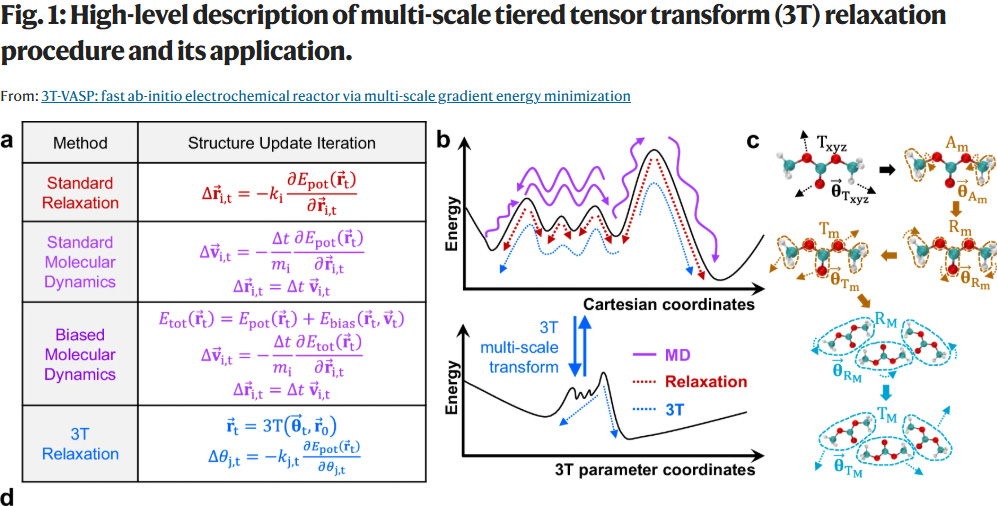
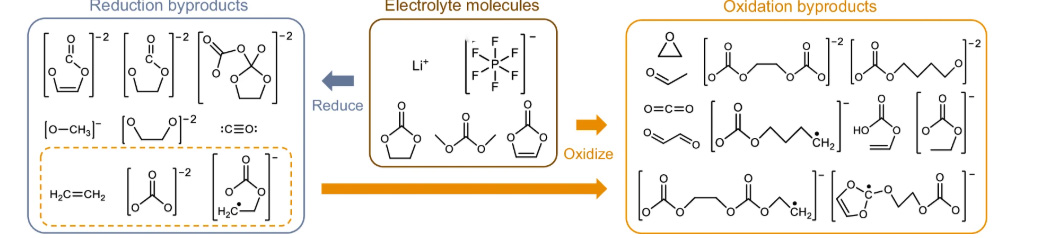
The caption:
Other figures are available at the full document.
It's all about solar cells and batteries, so in this case, the server on which this work was done is "green."
Right?
Well I guess it's more important (slightly) than talking about Kylie Jenner, whoever she is.
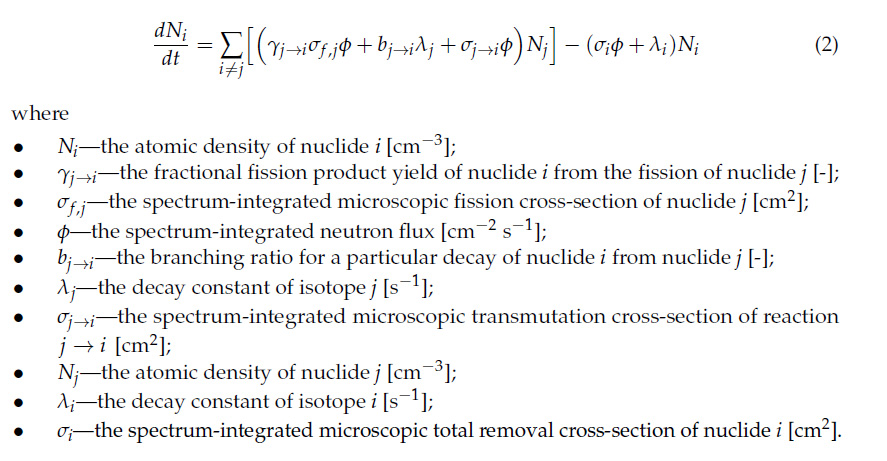
In any case, I personally believe that it is possible to produce reliable continuous electricity cleanly and without fossil fuels. The realization of this possibility involves to my mind, the fundamental equation of neutronics, the Bateman equation(s), a coupled series of differential equations generally solved by (gasp) computer power :
Have a nice day tomorrow.
 = new reply since forum marked as read
Highlight:
NoneDon't highlight anything
5 newestHighlight 5 most recent replies
= new reply since forum marked as read
Highlight:
NoneDon't highlight anything
5 newestHighlight 5 most recent replies

quaint
(4,681 posts)I try to educate myself before condemning technological advances, but I only understand one or two percent.
However, my common sense still says, no.

NNadir
(37,349 posts)Common sense is, in my view, vastly overrated. The word "common" means ordinary. To evaluate extraordinary technology requires extraordinary insight, work, and education, whether formal or autodidactically obtained.
RFK is a commoner. Nobel Laureate Katalin Kariko, whose work ultimately made RNA vaccines available is uncommon.
I oppose wind and solar energy because I do understand them, not because I don't understand them.
That is the difference between me and the orange pedophile in the White House. His position comes out of ignorance; mine out of detailed investigation.
He, similarly, supports fossil fuels out of ignorance; I oppose them because I have deep understanding of the consequences of their use.
Similarly, as a onetime antinuke I support nuclear energy because I looked into the details on a very deep level that ultimately bordered on, I confess, obsessive.
I have yet to meet an antinuke here or nearly anywhere who knows anything at all about nuclear energy other than they hate it.
DFT described in the OP is a very powerful tool. It can be used either in a positive or negative way, for good or for bad. How it is used is an ethical question, not a technical question. It represents a subset of the use of computational power, the use of which also is defined of ethics.
That is what is missing in our times, senses of ethics.

hunter
(40,394 posts)Most of it will be used for entertainment, consumer surveillance, and numerous pernicious uses.
We're already seeing AI produced propaganda here on DU. YouTube is flooded with AI produced videos, purporting to be true, that have little basis in reality.
More efficient and/or less expensive solar cells and batteries will not, of course, "save the world" and are only prolonging our dependence on fossil fuels.
NNadir
(37,349 posts)...are all at National Labs, which says something to me.
The Frontier Computer at Oak Ridge.
One used to be able to sign up to allow researchers to run routines on one's computer when not in use. I'm not sure if that system is still in place.
I am not immune from frivolous use of my computer, but I can say that the bulk of my personal scientific knowledge derives from Google Scholar guided access to electronic access to University Libraries.
My life was changed for the better when I had this access. It used to take me hours and hours simply to find one or two relevant papers to a topic that I needed to understand - and often I'd be disappointed with what that labor found - whereas now I can easily call up 20 or more papers in ten minutes, and run keyword searches in them when downloaded to get right to the "meat."
I certainly believe that the demand for electricity for computational power can do quite a bit to advance the use of nuclear power which may be the most important unintended side effect. This is not driven, to my mind, by the fact that nuclear power is environmentally and morally superior to all other forms of energy. Rather it is driven by reliability, an unintended consequence of the frivolity beyond better uses.
To me is not quite the same as endorsing the car CULTure, or, as is the case with my own hypocrisy condemning that CULTure while using it.
I think computational power is a route out of the hole we've dug for ourselves.
Recently I was informed by an antinuke here that the reason China has been able to build and bring on line more than 50 nuclear reactors in the last 20 years is that they "didn't ask for 'permission'." (That's another power that computers bring to us, the ability to understand how much ignorance is in the world, and to confront it.) I asked the functional idiot whose permission they should have requested, "his, hers or theirs." Whose "permission" will we need to determine how and when to use our computers? The Orange Pedophiles? Kegsbreath's? "I wannabe Roger Taney" Roberts? Pubic hair flosser Thomas? Drunken frat boy rapist Bret Kavanaugh's?
That's a dangerous slope if ever there was one.
To me, neither DU, nor Google Scholar, nor the electronic documents in University repositories (libraries) are frivolous. These uses are, to my mind, the essence of true freedom, the fifth freedom not mentioned by FDR, the Freedom to see and understand.
In this case, as in others, this genie cannot be put back in the bottle.
I support servers.