Human activities accelerate changes in the freshwater cycle
https://www.pik-potsdam.de/en/news/latest-news/human-activities-accelerate-changes-in-the-freshwater-cycle09.06.2026 – Climate change, land use and water use are significantly altering the global freshwater cycle at an increasing pace. This produces more widespread and frequent dry and wet periods, pushing freshwater systems further beyond its planetary boundary, according to a new study published in Nature Communications. Led by researchers at the University of Eastern Finland, with contributions from the Potsdam Institute for Climate Impact Research (PIK), the study provides an updated assessment of the planetary boundary for freshwater change and identifies the key drivers of its accelerating transgression at both global and regional scales.
…
Using data from 1901 to 2019, and an ensemble of global hydrological models, the researchers analysed quantitative changes in both “blue water” (in rivers, lakes and groundwater) and “green water” (in soils) around the world, distinguishing between the effects of human activities, through land and water use, and the effects through human-induced climate change on dry and wet anomalies.
“Changes in the freshwater cycle have been speeding up in recent decades, and projections indicate that this trend is likely to intensify further,” said lead author Vili Virkki from the University of Eastern Finland. “When the freshwater cycle changes faster than the environment can adapt, the risks of adverse impacts increase.”
According to the study, dry and wet anomalies now occur about twice as often as they did in the early 20th century, for both blue and green water. Regional patterns vary: While increasing dryness dominates in many tropical and subtropical regions, anomalously wet conditions have become more frequent in the northern boreal zone, reflected in floods and more prolonged, large-scale precipitation events.
…
https://www.planetaryhealthcheck.org/boundary/freshwater-change/
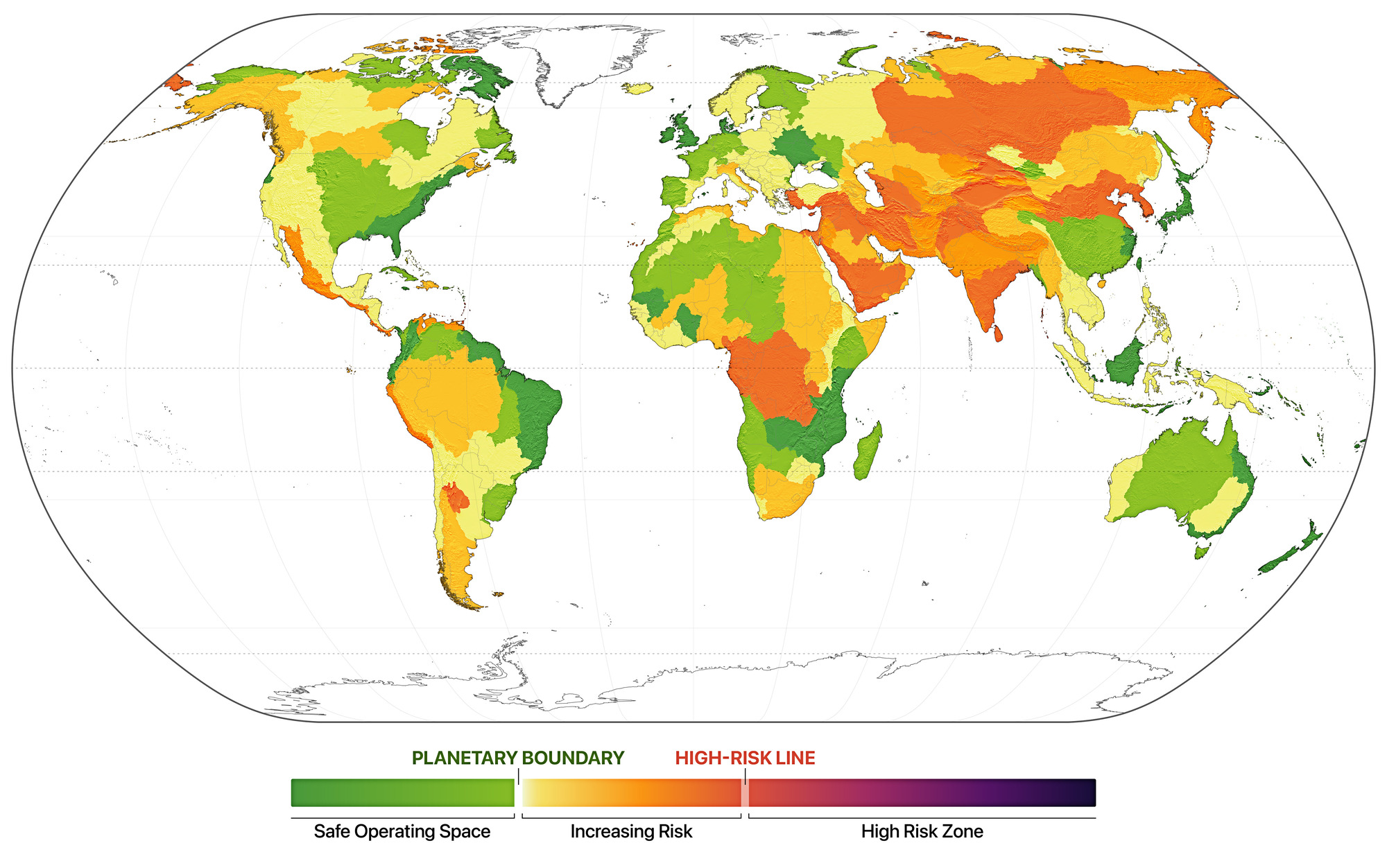
Virkki, V., Andersen, L.S., te Wierik, S.
et al. Regionally divergent drivers behind transgressions of the freshwater change planetary boundary.
Nat Commun 17, 5132 (2026).
https://doi.org/10.1038/s41467-026-73051-x
