Welcome to DU!
The truly grassroots left-of-center political community where regular people, not algorithms, drive the discussions and set the standards.
Join the community:
Create a free account
Support DU (and get rid of ads!):
Become a Star Member
Latest Breaking News
Editorials & Other Articles
General Discussion
The DU Lounge
All Forums
Issue Forums
Culture Forums
Alliance Forums
Region Forums
Support Forums
Help & Search
Environment & Energy
Related: About this forumMajor climate report shows Earth is getting hotter faster
https://www.leeds.ac.uk/news/article/5977/major-climate-report-shows-earth-is-getting-hotter-fasterDate 11 June 2026
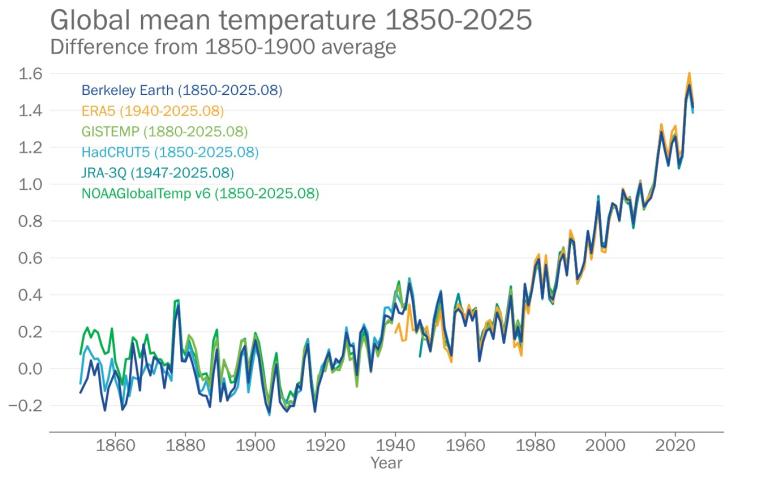
Human activities pushed global warming to 1.37°C in 2025, and its level is projected to surpass 1.5°C in about four years. Crucially, the rate at which heat is accumulating in the Earth system suggests high levels of future warming.
These are some of the key findings from the latest Indicators of Global Climate Change (IGCC) report, published today in Earth System Science Data.
An international team of more than 70 scientists, including IPCC Lead Authors, Contributing Authors, and Chapter Scientists, from 56 institutions across 17 countries contributed to this year’s IGCC study.
Professor Piers Forster, Director of the Priestley Centre for Climate Futures at the University of Leeds and lead author, said: “A key indicator is the Earth's energy imbalance, which measures how fast heat is accumulating in the climate system, and provides a crucial measure of the pace of climate change. Without human influence, it should be close to zero, but it has been growing since the 1970s and is now at a record high, doubling in recent decades.”
…
Forster, P. M., Walsh, T., Smith, C., Lamb, W. F., Lamboll, R., Cassou, C., Hauser, M., Hausfather, Z., Lee, J.-Y., Palmer, M. D., von Schuckmann, K., Slangen, A. B. A., Szopa, S., Trewin, B., Yun, J., Gillett, N. P., Jenkins, S., Matthews, H. D., Raghavan, K., Ribes, A., Rogelj, J., Rosen, D., Zhang, X., Allen, M., Andrew, R. M., Atkinson, C., Betts, R. A., Bombelli, A., Burgess, S. N., Cheng, L., Claxton, H. E., Friedlingstein, P., Frölicher, T. L., Domingues, C. M., Gasser, T., Gregory, C. H., Hoesly, R. M., Huppmann, D., Ishii, M., Kadow, C., Karwat, A., Kennedy, J., Killick, R. E., Kovilakam, M. V. M., Krummel, P. B., Lan, X., Lamarque, J.-F., Liné, A., Martín-Míguez, B., Monselesan, D. P., Morice, C., Mühle, J., Mussak, P., Peters, G. P., Pirani, A., Pongratz, J., Rigby, M., Rohde, R., Savita, A., Seneviratne, S. I., Smith, S. J., Taha, G., Tassone, C., Thorne, P., Wells, C., Western, L. M., van der Werf, G. R., Wijffels, S. E., Zecchetto, M., Zhong, J., Zhang, X.-Y., Masson-Delmotte, V., and Zhai, P.: Indicators of Global Climate Change 2025: annual update of key indicators of the state of the climate system and human influence, Earth Syst. Sci. Data, 18, 3889–3933, https://doi.org/10.5194/essd-18-3889-2026, 2026.Human activities pushed global warming to 1.37°C in 2025, and its level is projected to surpass 1.5°C in about four years. Crucially, the rate at which heat is accumulating in the Earth system suggests high levels of future warming.
These are some of the key findings from the latest Indicators of Global Climate Change (IGCC) report, published today in Earth System Science Data.
An international team of more than 70 scientists, including IPCC Lead Authors, Contributing Authors, and Chapter Scientists, from 56 institutions across 17 countries contributed to this year’s IGCC study.
Professor Piers Forster, Director of the Priestley Centre for Climate Futures at the University of Leeds and lead author, said: “A key indicator is the Earth's energy imbalance, which measures how fast heat is accumulating in the climate system, and provides a crucial measure of the pace of climate change. Without human influence, it should be close to zero, but it has been growing since the 1970s and is now at a record high, doubling in recent decades.”
…
5 replies
 = new reply since forum marked as read
Highlight:
NoneDon't highlight anything
5 newestHighlight 5 most recent replies
= new reply since forum marked as read
Highlight:
NoneDon't highlight anything
5 newestHighlight 5 most recent replies
= new reply since forum marked as read
Highlight:
NoneDon't highlight anything
5 newestHighlight 5 most recent replies
Major climate report shows Earth is getting hotter faster (Original Post)
OKIsItJustMe
Jun 11
OP

in2herbs
(4,700 posts)1. How much of the climate warming and air pollution can be attributed to wars, present and past? nt

Justice matters.
(10,309 posts)2. Yeah, those MASSIVE plumes of hot carbon up in the skies eh?
Like thousands of them in such a short period of time...
It's a hoax, alright... 

OKIsItJustMe
(22,504 posts)3. They don't help
Last edited Thu Jun 11, 2026, 03:56 PM - Edit history (2)
WW II, especially the industrial aspects of building ships, planes, tanks… made a significant contribution. Can you pick out WW II on this graph?
https://earth.org/iran-war-drives-massive-surge-in-planet-heating-emissions-amid-calls-to-accelerate-transition-to-renewables/
Iran War Drives Massive Surge in Planet-Heating Emissions Amid Calls to Accelerate Transition to Renewables
BY JAN LEE MIDDLE EAST MAR 24TH 2026
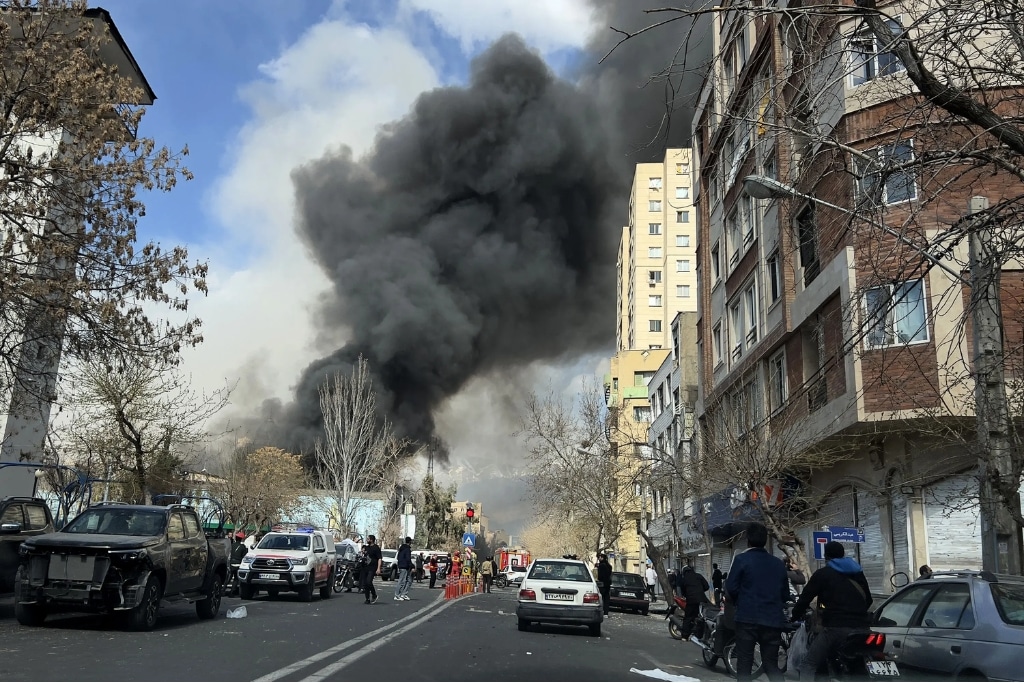 With the first 14 days of conflict in the Middle East unleashing emissions exceeding the annual footprint of Iceland, the race is on to understand the short- and long-term climate impact of this latest chapter in modern warfare.
“World leaders do this, while I’m expected to save the planet by drinking from a soggy paper straw? Life’s not fair,” reads a meme accompanied by an image of explosions and warplanes, highlighting the disconnect between everyday conservationism and the profligacy of wartime emissions.
…
Difficult to Calculate
An analysis by the Climate and Community Institute has found that the total greenhouse gas emissions from the first 14 days of assault is more than 5 million tonnes of carbon dioxide, which is higher than the total climate pollution of Iceland in 2024. But exact emissions are notoriously difficult to calculate.
De Klerk’s team estimates that Russia’s full-scale invasion of Ukraine, now going into its fifth year, has already emitted 311 million tons of greenhouse gas equivalents, while the war in Gaza has emitted 32 tons over two years. “Now we’re talking about two weeks, it’s a couple of million tons of CO2 for this war. Just direct emissions from warfare,” he told Earth.Org.
Along with the emissions from military vehicles and aircraft, immediate contributions to global warming can include emissions from fires and explosions. However, de Klerk said, “People tend to think that explosions of attacks on depots and oil refineries generate a lot of greenhouse gas emissions, but the biggest impact is the fuel consumption by both Israel and US military, the kerosene used by the fighter jets and the diesel used by the US navy. The emissions from fuel consumption are 20 to 30 times bigger than those from the destruction from the energy infrastructure.”
…
BY JAN LEE MIDDLE EAST MAR 24TH 2026
With the first 14 days of conflict in the Middle East unleashing emissions exceeding the annual footprint of Iceland, the race is on to understand the short- and long-term climate impact of this latest chapter in modern warfare.
“World leaders do this, while I’m expected to save the planet by drinking from a soggy paper straw? Life’s not fair,” reads a meme accompanied by an image of explosions and warplanes, highlighting the disconnect between everyday conservationism and the profligacy of wartime emissions.
…
Difficult to Calculate
An analysis by the Climate and Community Institute has found that the total greenhouse gas emissions from the first 14 days of assault is more than 5 million tonnes of carbon dioxide, which is higher than the total climate pollution of Iceland in 2024. But exact emissions are notoriously difficult to calculate.
De Klerk’s team estimates that Russia’s full-scale invasion of Ukraine, now going into its fifth year, has already emitted 311 million tons of greenhouse gas equivalents, while the war in Gaza has emitted 32 tons over two years. “Now we’re talking about two weeks, it’s a couple of million tons of CO2 for this war. Just direct emissions from warfare,” he told Earth.Org.
Along with the emissions from military vehicles and aircraft, immediate contributions to global warming can include emissions from fires and explosions. However, de Klerk said, “People tend to think that explosions of attacks on depots and oil refineries generate a lot of greenhouse gas emissions, but the biggest impact is the fuel consumption by both Israel and US military, the kerosene used by the fighter jets and the diesel used by the US navy. The emissions from fuel consumption are 20 to 30 times bigger than those from the destruction from the energy infrastructure.”
…
in2herbs
(4,700 posts)4. Thaks for the posting with info. nt
OKIsItJustMe
(22,504 posts)5. You're welcome!
I prefer data to supposition.