Environment & Energy
Related: About this forum
Canada: New motor vehicle registrations, first quarter 2026
I really need to take a break from my tablet.
Released: 2026-06-11
Canadians registered 397,601 new motor vehicles in the first quarter, a decrease of 6.9% from the first quarter of 2025 and a decrease of 3.7% from the fourth quarter of 2025.
Among vehicle types, new registrations for vans (+4.5%) experienced the sole growth in the first quarter of 2026. Meanwhile, pickup trucks (-11.5%), passenger cars (-11.0%) and multipurpose vehicles (-5.3%) declined compared with the first quarter of 2025.
In terms of fuel type, only zero-emission vehicles (ZEVs) saw growth in new registrations in the first quarter of 2026, with those of plug-in hybrid electric vehicles increasing by 22.9% and those of battery electric vehicles increasing by 12.9%. In contrast, new registrations of diesel-powered vehicles (-25.8%), gasoline-powered vehicles (-9.2%) and hybrid electric vehicles (-0.5%) decreased compared with the first quarter of 2025.
{snip}
 = new reply since forum marked as read
Highlight:
NoneDon't highlight anything
5 newestHighlight 5 most recent replies
= new reply since forum marked as read
Highlight:
NoneDon't highlight anything
5 newestHighlight 5 most recent replies

NNadir
(38,817 posts)Quebec, Newfoundland, and Manatobia and British Columbia each have carbon intensity below 100 grams of CO2 per kwh. Ontario is close at 111 g CO2/kwh.
The first four rely on hydroelectricity which is considered "green" if one does not care about riparian and riverine ecosystems. (I do, but I'm eccentric.) Ontario's largest source of electricity is nuclear, using the magnificent CANDU reactors. They do burn some gas, but should be able to reduce this reliance when the Bruce reactor refurbishments are completed. The refurbishments have been proceeding in an excellent fashion, under budget and ahead of schedule. Units 1 and 2 are completed, as has that of unit 6. The refurbishment of units 3 and 4 are underway.
Electric cars are not sustainable anywhere in the world owing to material constraints and embodied energy; but then again there are no cars of any type that are sustainable. In Canada however electric and plug in hybid cars are the least offensive.
There are no grids in the United States that have carbon intensity below 100 grams of CO2. On my grid, PJM, an electric car is dirtier in carbon intensity, if one includes embodied energy as one should, than a straight up internal combustion engine car, and a hybrid is only marginally better than an internal combustion engine car.
The only grids in Canada that rely heavily on fossil fuels are Alberta and Saskatchewan. The only grid in Canada to depend heavily on coal, the worst fossil fuel, is Saskatchewan.

Finishline42
(1,179 posts)Plus you can install solar panels on your roof so as to reduce the reliance on your grid.
This person has another view...
Link to tweet
?s=20
Finishline42
(1,179 posts)There really are people who believe that hybrid is a good idea. 🤦
It isn't.
It's a tax-saving model – and a lie that the auto industry loves to sell.
You're paying for two drive systems.
You're maintaining two drive systems. Oil changes, spark plugs, timing belts, exhaust system – it's all still there.
Plus battery, electric motor, inverter, and a transmission that has to coordinate both systems.
"Best of both worlds"? No.
Both sets of maintenance costs.
Both sets of failure points.
An EV: Tires, brakes, cabin filter. That's it. Brakes last longer because regenerative braking does most of the work. No oil. No transmission fluid. No engine coolant.
A hybrid can never be as structurally cheap as an EV.
Complexity costs – in production and in operation. Always.
The "transitional compromise" makes sense if you truly have no charging infrastructure. But anyone selling hybrid as a long-term economical choice is simply ignoring the cost structure.
Simpler wins. Always.
NNadir
(38,817 posts)...it doesn't matter how efficient a battery or a car is if it is run on electricity, particularly if the electricity is generated from fossil fuels.
A thermodynamic shell game is a crime against humanity, and that doesn't even count the moral cost of mining crap for batteries and electric cars, which are mass intensive.
Now, I know that there are zero "I'm not an antinuke" antinukes who bother to read a scientific paper, but as I'm pronuclear I obviously have done my homework, in fact about the area in which I live, on the PJM grid, where antinukes have worked to make my electricity particularly dirty, even more dirty than dirty German electricity, which is over 1000% more dirty than French electricity if one checks the annual figures on the Electricity Map. (As of this writing, the German carbon intensity on an annual basis is 342 grams CO2/kWh, France's 31 grams CO2/kWh, PJM 418 grams CO2/kWh.)
I covered a paper written about the energy intensity of electric, hybrid, and internal combustion engine on my grid here:
A paper addressing the idea that electric cars are "green."
From that post, from a paper published a little over two years ago, Cleaning up while Changing Gears: The Role of Battery Design, Fossil Fuel Power Plants, and Vehicle Policy for Reducing Emissions in the Transition to Electric Vehicles Matthew Bruchon, Zihao Lance Chen, and Jeremy Michalek Environmental Science & Technology 2024 58 (8), 3787-3799, the following graphic, in which environmental destruction associated with batteries has been monetized:
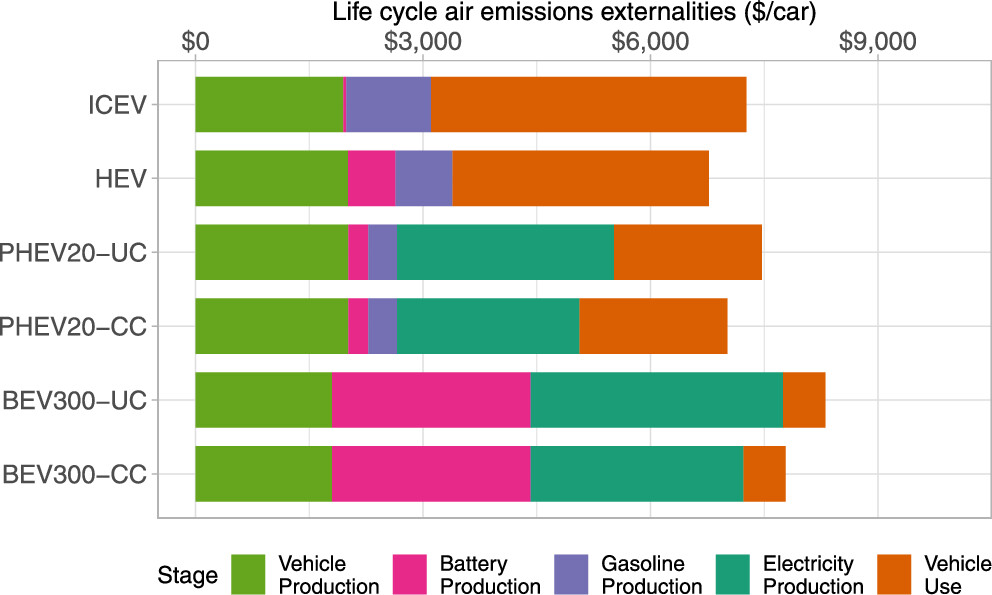
I drive a hybrid car, which on my grid, if one includes embodied energy - a subject about which apologists thermodynamic ignorance and obscene mineral mining couldn't care less - is slightly better than an ICEV (Internal Combustion Engine Vehicle. My car is decidedly not green, and there was no tax incentive to buy it; in fact at the time I bought it I paid a premium of about $7,000 more than I would have paid for an ICEV version of the car.
Of course, I'm not entirely bourgeois in the sense that I don't monetize the environmental destruction associated with the morally appalling apologetics with contempt for the laws of thermodynamics as battery apologists do. The fact that the battery industry has been described as the dirtiest supply chain on Earth resonates with me and everything I know, since I have managed to avoid being scientifically illiterate and can say, at the end of my life, have made modest strides at trying to be more importantly morally aware, although I am, at the end of the day, since I drive a car, decidedly a bourgeois pig. I just don't caterwaul with mindless excuses for it.