Environment & Energy
Related: About this forum
Fluorinated Lithium Salts: A Significant Class of Environmental Pollutants from Spent Lithium-Ion Batteries.
The paper to which I'll briefly refer in this post is this one: Fluorinated Lithium Salts: A Significant Class of Environmental Pollutants of Emerging Concern from Spent Lithium-Ion Battery Recycling Xiang Ge, Jiali Ge, Bibai Du, Weisheng Luo, Jingwei Zhao, Jiabei He, Mingyang Xing, and Lixi Zeng Environmental Science & Technology 2026 60 (14), 11013-11021.
The awful hydra that seems to never go away as we race to the destruction of the planetary atmosphere is that there is a "green" redundancy that can make the useless solar and wind industries reliable. These claims come in two forms, hydrogen and batteries, neither of which has done much to address the fact that the main real means of addressing the appalling lack of reliability for so called "renewable energy" is fossil fuels. Still these thermodynamic nonsense schemes still fly around; we see them all the time here at DU and more broadly in the world at large, even in the scientific literature. So called "renewable energy" is mass intensive, which is the main reason it is not sustainable, and batteries worsen that reality, even if they are insufficient to prevent the use of fossil fuels.
There's a lot of handwaving about the mass intensity of so called "renewable energy," most of relying on a presumed magic approach to recycling. Recycling does not work very well in any setting where the mass is large, and the materials to be recycled are diffuse. There is also the problem of energy for transport, separating the components to be recycled, and processing, particularly where heat is involved.
Another issue is toxicity. Toxicity is what the paper cited is about.
From the introduction:
Generally, LIB electrolytes are composed of approximately 83% solvent, 12% fluorinated Li salts, and 5% functional additives. (10,11) Fluorinated Li salts are of emerging concern to the environmental science community because of their high potentials to contribute to Li exposure, as well as their PFAS-like persistence, mobility, bioaccumulation, and toxicity. Currently, lithium hexafluorophosphate (LiPF6) is the most commonly used fluorinated Li salt in commercial LIB electrolyte formulations due to its high ionic conductivity and excellent compatibility with graphite anodes. (12) Between 2019 and 2024, global shipments of LiPF6 increased from 36,000 to 208,000 tons. (13) Besides LiPF6, multiple emerging fluorinated Li salts, for example, lithium bis(fluorosulfonyl)imide (LiFSI) and lithium bis(trifluoromethanesulfonyl)imide (LiTFSI), are also widely applied in commercial LIBs and considered promising replacements for LiPF6. (14) In commercial electrolyte formulations for LIBs, a combination of multiple fluorinated Li salts is often used to achieve superior electrochemical performance. When end-of-life LIBs are retired, the first treatment processes, which include dismantling, shredding, grinding, milling, and pyrolysis, produce a dark, powdery substance known as “black mass” (BM), which serves as the primary feedstock for downstream recycling processes for valuable metals. BM is mainly composed of graphite anode materials from LIBs, mixed with small amounts of cathode metals, residual electrolytes, and binders. (15) During spent LIB recycling processes, fluorinated Li salts, as additive chemicals, are inevitably released into the surrounding environment, posing potential risks to the environment, ecology, and human health...
I contend that the only way so called "renewable energy" can be considered green is to complete ignore the environmental impact of recycling massive amounts of material. (In an upcoming post on which I'm working, I will consider the case of recycling solar garbage itself, and not the redundant battery systems designed to pretend that the real back up is not dangerous fossil fuels.)
Some figures from the text of the present paper:
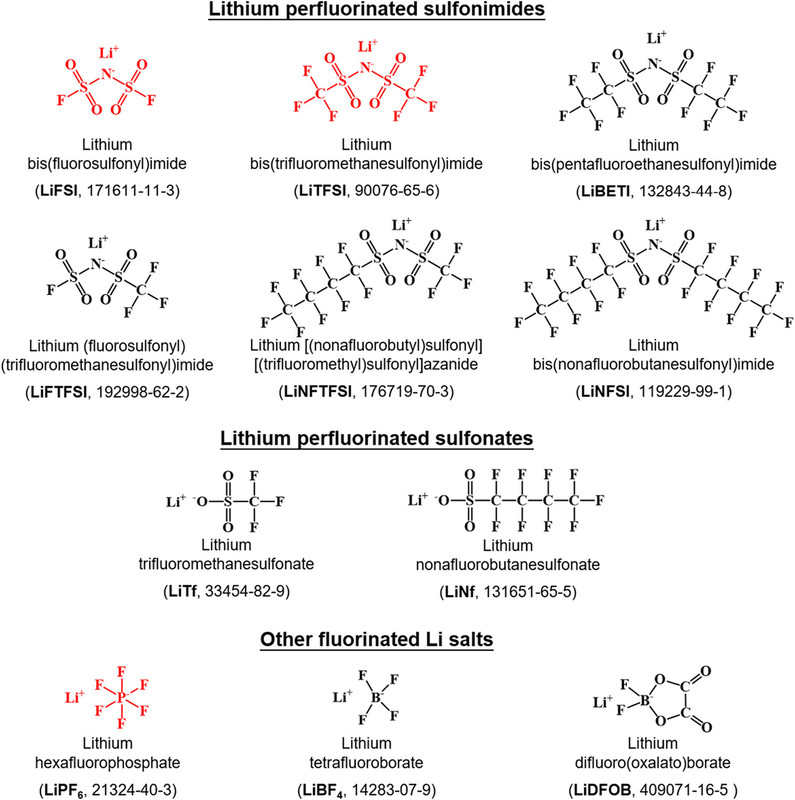
The caption:
These anions are of a type typical in a class of compounds known as "ionic liquids." There are basically a possible infinite number of these, but in this case, they are primarily focused on anions coming from the PFAS group, fluorinated chemicals that are of rapidly rising concern because of their persistence, suspected and known toxicity. They are very hard to destroy, given the strength of the carbon fluorine bond, with a bond energy requiring UV or shorter radiation (x-rays and gamma rays) to cleave the bond.
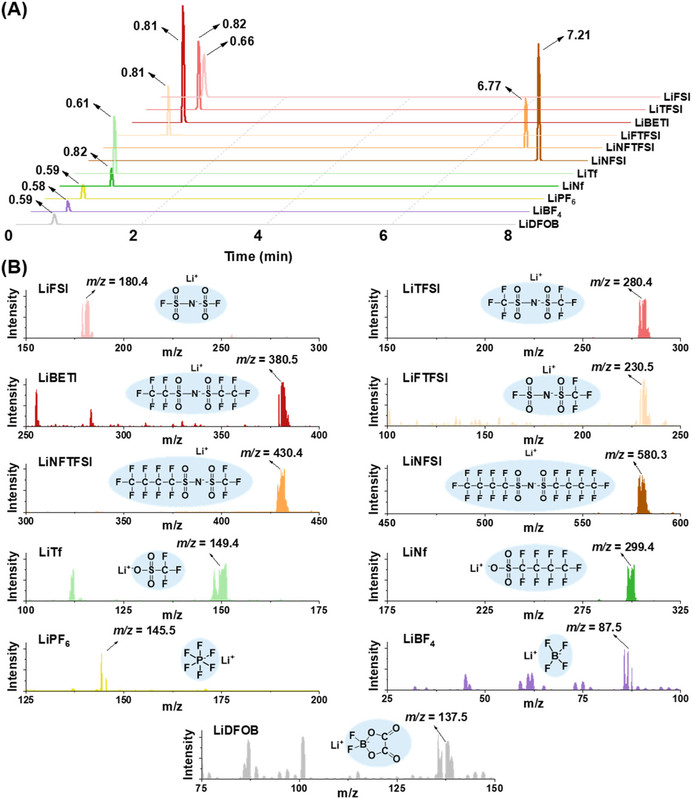
The caption:
This is triple quad mass spec results. The analytical chemistry of PFAS, because of the rising concern, is a major area of research.
The mass spec utilized is nothing spectacular, simply a Sciex 5500, which works well if one knows for what one is looking. (NTA, nontargeted analysis requires high resolution mass spec and often considerable computer time and power. NTA analysis is required for tracking degradants of PFAS and is analytically challenging.)
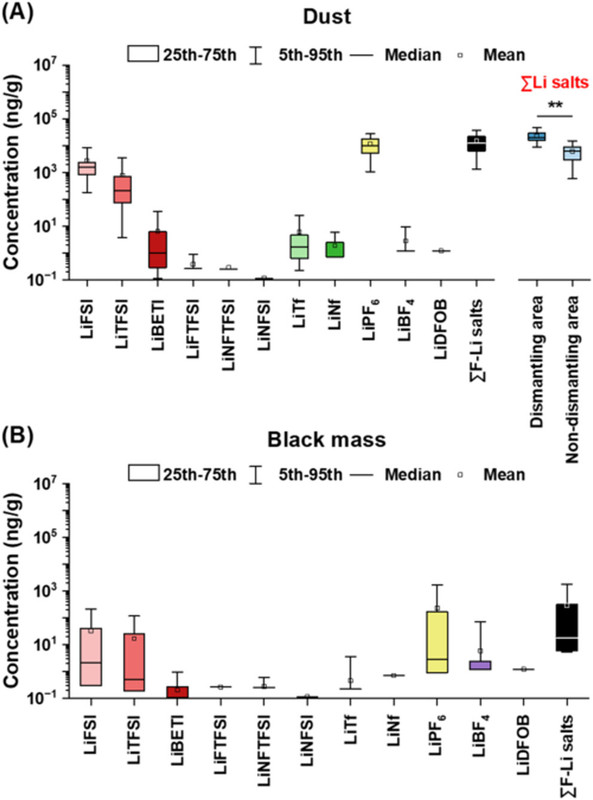
The caption:
These are concentrations of physiologic concern. Many substances work for good or for bad at the picogram level; these are at nanogram concentrations.
A table from the text is more accurate and covers analysis of many samples:
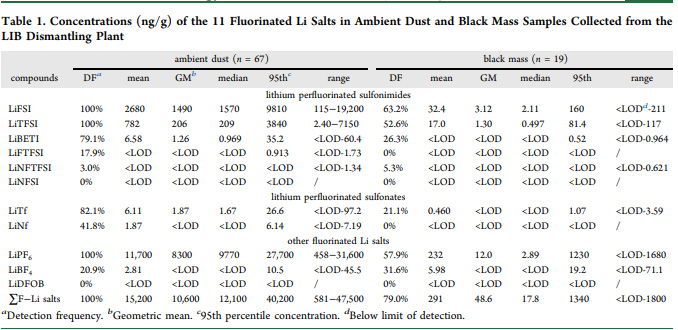
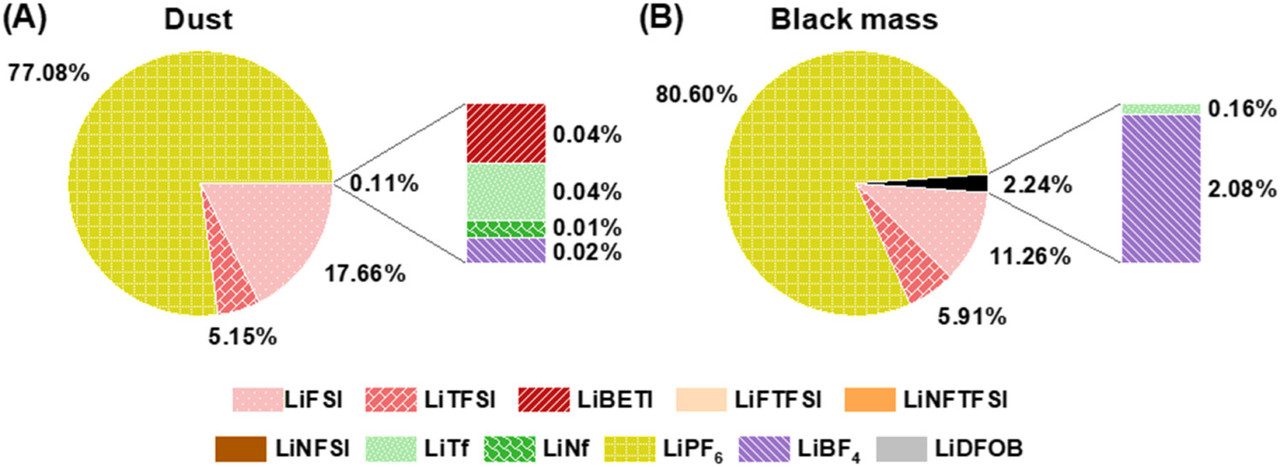
The caption:
Figure 4. Composition profiles of the 11 fluorinated Li salts in dust (A) and black mass (B) samples from the LIB dismantling plant.
Some comments from the conclusion:
(2) Current investigations have primarily focused on dust and black mass samples collected from an LIB dismantling plant, whereas the pollution levels in the air, which may serve as a key medium governing the migration of fluorinated Li salts within and beyond the LIB recycling facilities, remain unknown. Soil and vegetation near these recycling sites may have accumulated fluorinated Li salts owing to their affinity for organic carbon. Rainfall and surface runoff promote the transport of fluorinated Li salts into adjacent aquatic systems...
One sees in the literature many cases where the substitute for a problematic substance eliminates one problem only to create another, potentially worse. The invention of the automobile, which represents a profound environmental tragedy was invented to help solve the problem of horse manure on city streets. The collapse of the planetary atmosphere, for which the automobile represents a significant causative agent, is worse than horse manure I think. There is a big lie floating around that so called "renewable energy" can make automobiles "green" via batteries. This is nonsense for many reasons, not limited to the toxicology of battery recycling and the moral cost of mining for battery materials for virgin batteries.
The car CULTure is not sustainable by any means.
A cautionary tale, I think...
Have a nice day tomorrow.
 = new reply since forum marked as read
Highlight:
NoneDon't highlight anything
5 newestHighlight 5 most recent replies
= new reply since forum marked as read
Highlight:
NoneDon't highlight anything
5 newestHighlight 5 most recent replies
