Religion
Related: About this forumDid religion ever bring anything to mankind?
I can think of only one tangible positive input of religion, which I will present at the end (C).
But first, I would like to debunk the false claims (A) and the real ills (B) of religion:
(A) False claims:
1- No theoretical benefit: religion did not bring morality to mankind
Morality is the rules and opinions of the overwhelming majority.
If murder was condoned, life would be made worse (some psychopaths might disagree)
If theft was OK, the society's global efficiency would decrease (thieves and traders disagree)
All these basic rules exist in all societies, even in those which did not invent gods.
2- No social benefit: no link between religiosity and good behavior can be found
Studies have been made to try to correlate religious belief and levels of crime (murder, theft, rape) or abuse (drugs, alcohol). Not one of them found a positive correlation between belief and lower crime or abuse (there is even a slight correlation the wrong way)
3- Any supernatural claim of religion is either unproven or debunked
As scientific and communications means progress, claims of miracles recess. The last religious leader with lots of followers who claimed to perform miracles was Sathya Sai Baba. He always refused to perform his 'miracles' in front of a group of experts (scientists+trained magicians). But he did get caught on tape in what does look like cheap magic tricks.
As for other simpler benefits, like that of prayer, there has been only one large scientific quantitative study. Again, no or slightly negative benefit between prayer and one desired outcome.
4- the error riddled 'holy' books never created any good
Since the holy books are full of scientific mistakes and immoral decrees, they can not be moral compasses. The moral compass is brought by the reader to find passages which are fit for consumption.
5- the good done by believers is independent of religion
Religions claimed to be the channels of goodness, so people wanting to do good were enticed to do good in the name of those ideologies. But, as Doctors without Borders or other secular NGOs demonstrate, churches or NGOs are just conduits helping individuals channel their inner goodness.
(B) Tangible negative outcomes brought about by religion
Endless list. Some tokens: conversions by the sword (Frankish Empire, South America for Christianity, most of today's muslim world for Islam), Christian burning of witches, death for multiple imaginary offenses in Islam, imaginary title deed on some Mediterranean land in Judaism, ditto in Hinduism, etc. (not mentioning Celtic/Mayan/Moloch human sacrifices).
And in general modern terms, mutual exclusion rules: only Jesus/Allah/whatever saves.
(C) there is one benefit of religions: that of an appeasing placebo.
In Antiquity, religions pinned events on imaginary beings (from Thor to Allah), and this helped quell the fears of the population. It had an evolutionary benefit in that it helped societies relieve their angst. Earthquakes would go away after the sacrifice of this goat or that baby. A positive outcome, except for the goat/baby/female virgin/whatever. But one can't make religious omelettes without breaking one or two mammals.
In modern times, it is true that invoking the image of paradise will lessen the grief of a mother who just lost a young child. A real, tangible psychological benefit whose only fault is that it is grounded in a probably imaginary promise.
By all means, I do not have an axe to grind against religions. It's just that I do not see any real demonstrable benefits in today's world while I do see some real life problems caused by religion (People against stem cell research or gay marriages in the US. Charlie Hebdo, ISIS, Boko Haram, al Shebab, Saudi Arabia and the Talibans also come to mind)
Now, if you can come forward with demonstrable, tangible benefits of religion, I am quite willing to listen.
 = new reply since forum marked as read
Highlight:
NoneDon't highlight anything
5 newestHighlight 5 most recent replies
= new reply since forum marked as read
Highlight:
NoneDon't highlight anything
5 newestHighlight 5 most recent replies

Cartoonist
(7,579 posts)One poster here will decry your OP as flamebait. This will not stop her from taking the bait and flaming away.
Another poster, who will probably only respond with a snide remark, likes to name religious figures who clean up after other religious figures, e.g., abolitionists fighting slavery by Baptists.
Yorktown
(2,884 posts)I do not know who your two posters are, but as to the two categories of rebuttal you mention:
• a flameback (the OP is not flamebait) would not tackle the issue: what is the good of religion?
• as for the religious figures who did good, I pre-answered it in my point A5.
I might add on this point that before the invention of monotheism, polytheists too were doing good deeds. Humans do good deeds irrespective of their imaginary ideologies. Unless someone can bring tangible evidence this or that religion brought original goodness to humanity.
Cartoonist
(7,579 posts)But you will get a response here from people who see religion as good. Point A5 will have no resonance with them.

LTX
(1,020 posts)The principal problem is that it relies on some rather rudimentary misconceptions and some rather glaring inaccuracies. But it fits neatly within the confirmation biases of contemporary atheism, so it's not particularly surprising that it found some cheerleaders here.
Cartoonist
(7,579 posts)Isn't that the definition of religion?
LTX
(1,020 posts)would not rely on what you view as a fundamental deficiency of religious thinking. Aren't you a proponent of a purely evidence-based ideology?
Cartoonist
(7,579 posts)First present evidence. Then make a point.
LTX
(1,020 posts)which reside at the tail end of this thread. Perhaps you will address them, since the author of the OP has chosen not to. They were intended as an invitation to further critical examination of the OP's hypothesis.
Cartoonist
(7,579 posts)I stand with the OP.

cbayer
(146,218 posts)Go figure.
Cartoonist
(7,579 posts)Probably why I don't talk with you much.
Yorktown
(2,884 posts)Not one attempt to seriously answer the OP's question:
can anyone here demonstrate some tangible positive input brought about by religion?
And, no, religiously inspired Art doesn't count.

LTX
(1,020 posts)Odd that you seem determined to prove my point -- that contemporary atheism is surprisingly rife with the very type of evidence-free assertiveness that atheists find contemptible in theists. The human computer is a deeply curious machine.
Cartoonist
(7,579 posts)You still haven't said anything of substance. Just that you disagree with the OP. Bring something to the discussion.
LTX
(1,020 posts)at the bottom of the thread (why does the ghost of Sgt. Shultz seem to be floating around on my computer screen?), let's go at it this way. Please defend for me the following flat-out false statement contained in the OP:
"Studies have been made to try to correlate religious belief and levels of crime (murder, theft, rape) or abuse (drugs, alcohol). Not one of them found a positive correlation between belief and lower crime or abuse (there is even a slight correlation the wrong way)"
Then inform me about the societies that have invented no gods, and explain why the OP's singular (supposedly evolutionary) benefit of religious thinking is not simply one in a plethora of proposed just-so evolutionary benefits.
Cartoonist
(7,579 posts)Go back and read it.
I don't know about Paragraph 3. So?
You still haven't brought anything to the discussion but disagreement. I find you tiresome.
LTX
(1,020 posts)Cartoonist
(7,579 posts)Response to LTX (Reply #154)
Yorktown This message was self-deleted by its author.
Response to LTX (Reply #143)
Yorktown This message was self-deleted by its author.
Yorktown
(2,884 posts)Let's even assume, for argument sake, that my OP contains 'rudimentary misconceptions and some rather glaring inaccuracies' (a point I would dispute, but never mind)
The basic question I put is:
can anyone here demonstrate some tangible positive input brought about by religion?
Up to now, I heard off topic answers (Art), then crickets. You now add 'shoot the messenger'
I still do not see the shadow of a substatntive answer.
LTX
(1,020 posts)One is a fairly standard trope selected from the evolutionary just-so bucket. I tend to agree with Boyer that, while the contents of that bucket do not explain the root neurological phenomenon of religion, they nevertheless merit consideration as "tangible" corroboration of religion's effects, both negative and positive.
While you seem to discount the importance of your own "comfort" selection (and seem to have little interest in exploring the balance of the bucket), you nevertheless concede "a tangible positive input." Maybe your own, current material contentment has just temporarily dulled your ability to empathize with an enormous swath of humanity for whom "comfort" is more than dismissible silliness.
The second is the demonstrable inverse of your assertion in your point #2. While one can argue the causation/correlation question, you nevertheless acknowledge by your own framing of the issue that a mere "link" is significant.
Your question is good. But I wouldn't look to the necessarily short-form content of a message board for any kind of confirmation of your own (apparently pre-determined) answer to it. Boyer devoted more than 360 pages to an exploration of religion's origins and anthropological ramifications, and his well-researched and insightful contribution is just a sliver of the available pie.
On edit, I'm still curious about which societies invented no gods. Perhaps you can provide some examples. I confess to being ignorant of their existence.
Yorktown
(2,884 posts)I'll answer in disorder:
A very good point. Two answers.
• First, I'm no anthropologist, so my answer won't be comprehensive or precise, but I seem to remember there were tribes in South America which only loosely believed in 'Nature' without hope of intercession, and, from wiki, "Will Durant explains that certain pygmy tribes found in Africa were observed to have no identifiable cults or rites.". It would not be a stretch to add in Jainism, and even Buddhism even if the latter is heavily laced with folk superstitions.
• Second, even if I still would grant that most societies did invent gods, among them and very early on, schools of doubters and atheists appeared: "Religion is regarded by the common people as true, by the wise as false, and by the rulers as useful." - Lucius Annaeus Seneca
That brings me to your key point:
One word about my 'material contentment'. I twice faced the prospect of real death.
And I realized years later that during the instant or days when those two occurences happened, the thought of a god never crossed my mind. "comfort" had no bearing on my (un)belief.
Other than that, yes, I did grant straightaway the placebo effect in primitive societies.
And yes, at the time, that credulous belief probably held an evolutionary benefit.
So, we agree: All religion brought is a beneficial placebo effect to primitive societies.
If all participants on this thread agree on this, I'm OK. Shall we bet it won't happen?

Lastly, I'd be far more sarcastic about your last point:
Very cunningly put. But..
I would also acknowledge that there is more than a mere "link" between Nazism and the notion of well-being of the Reichsvolk. Or between Stalinism and the well-being of the proletariat. Actually, it's more than a 'mere' link, it's an explicit link: religions claim morality and goodness in the same way that Nazism claimed the 'salvation' of the 'superior German race'. But I think it could be argued that the wars of religious conquests killed more than Nazism. Actually, Hitler was dumb. Had he claimed to have revelations from 'god', he might have lasted longer to kill more. Poor guy, Goebbels couldn't sell him a proper communication platform. While Arnaud Amalric is far less vilified by historians: Caedite eos. Novit enim Dominus qui sunt eius. ("Kill them. For the Lord knows those that are His own."
Yorktown
(2,884 posts)Just curious.
stone space
(6,498 posts)...who find ourselves in the minority.
Is this where the term "Moral Majority" comes from?
Yorktown
(2,884 posts)Overwhelming majorities disapprove of murder, theft and rape.
When the majority is not overwhelming, you have moral dilemmas or conflicts.
The earliest I know to suggest morality is linked to opinion were Spinoza and Machiavelli.
(if anyone can suggest someone before that with quotes, I'm interested)
stone space
(6,498 posts)They were wrong.
We were right.

Yorktown
(2,884 posts)Take just the US. Nominally, it's still a country with a vast Christian majority.
And yet, the majority in the US now support same sex marriages.
Which proves
a- that morality is the opinion of the majority and varies over time
b- that religious affiliation (thankfully) does not provide a fixed moral compass
stone space
(6,498 posts)a- that morality is the opinion of the majority and varies over time
Denying gay couples the right to marry was as immoral then as it is now.
It is silly for folks now to make the claim that we were wrong then simply because our view was then a minority view and has only since become a majority view.
We are talking about morality here, not "victor's justice".
Yorktown
(2,884 posts)I say
You say
Observe the paradox: Who is going to say what morality was then or now?
You and I apparently were supporters of same sex marriages all along.
Who is to say our stance is 'moral'? Literalist Christians or Muslims disagree.
Universal morality = overwhelming majority (murder, theft, rape)
Majority morality = majority opinion (same sex marriages)
In Christian Victorian England, theft by someone starving = hard labor. Was it moral?
stone space
(6,498 posts)I did then, and I do now.
What exactly do you find paradoxical about it?
Is the fact that somebody might disagree with me (then or now) somehow paradoxical?
Yorktown
(2,884 posts)Cool.

stone space
(6,498 posts)We can appeal to higher authorities like "overwhelming opinion", I suppose, but that will only work so long as we agree with "overwhelming opinion".
It's not very useful when one is engaged in a moral struggle in opposition to "overwhelming opinion".
Your definition of morality sounds a lot like "might makes right" to me. (See also "victor's justice", as I pointed out above.)
Yorktown
(2,884 posts)As is brute force. (Motto of the 1st Battalion 11th Marines: Ultima Ratio Regum)
After all, might is right is how Judaism, Christianity and Islam grew.
But thankfully, ultimately, morality is grounded in natural evolution which is good for the species.
No animal like to be trapped, forced -> freedom.
No animal likes to be stolen from -> thou shall not steal
Murder doesn't foster species survival -> thou shall not kill
This includes your point on same sex unions: they exist among all mammal species.
(even though the evolutionary reason is not understood)
One can therefore say there is a natural ground for the morality of accepting homosexuality.
Anyway, in short, individuals in the minority can discern what should become morality, but it won't be sanctioned as the morality of society as long as the majority isn't won over.
stone space
(6,498 posts)It's all about humans.
I do not support opening up marriage to other mammal species.
Yorktown
(2,884 posts)I was stating that homosexuality occurs in the 5 to 10% bracket in many mammal species.
Ergo that human homosexuality was grounded in nature.
I was not advocating zoophilia.
stone space
(6,498 posts)Other species don't have civil marriage.
Does that make civil marriage immoral?
In any case, this argument seems to be moving the goalposts.
You were originally making an argument for defining morality by an appeal to authority.
Suddenly we've gone from "overwhelming opinion" to "grounded in nature".
Yorktown
(2,884 posts)The age old heterosexual marriage is equivalent to that in mammals (ex:penguins)
The same sex unions now declared 'moral' also had an equivalent in other mammals (penguins)
One solid basis for 'morality' is the evolutionary behavior of species.
It was therefore probable homosexual marriages would end up being declared moral.
(even if most Christians and nearly all Muslims disagree)
But if Nature is one of the bases for morality intellectually, it remains inoperative as long as the majority in society disagrees. Case in point: you and I might agree that same sex marriages are moral, but good luck trying to sell that to the citizenry of today's Saudi Arabia.
Anyway, we're straying far from the main question of this thread:
what original positive contributions to mankind did religions make?
stone space
(6,498 posts)I'm simply disagreeing with your defining morality via an appeal to authority.
I'm been too often in the minority when it comes to my moral views to let "overwhelming opinion" define morality for me.
And evolution is not a moral guide for me. It's just a scientific theory, that's all. Like gravity.
I don't base my morality on gravity, either.
Yorktown
(2,884 posts)Let's assume you and I are totally right: same sex marriage is moral. No question.
Yet, the morality of in Saudi Arabia would still be different.
An overwhelming percentage of today's Saudis will declare same sex marriage abhorrent.
Based on Scripture, validated by majority rule. And they will call it morality.
Do you see the paradox now? Morality is defined by humans (ergo, majorities)
Even if there can be some 'objective' grounds to argue for certain positions (natural evolution)
stone space
(6,498 posts)I've never seen it as being somehow paradoxical.
Sure, it's fun being in the majority from time to time, but there is much more to morality than fun.
There is work involved.
Yorktown
(2,884 posts)There are different schools of thought on the roots and grounding of morality. They can differ.
But the influence of the majority opinion on morality is impossible to entirely negate.
In example of same sex marriage US vs Saudi views, the groundings explaining the different conclusions are Nature vs Religion.
And in each case, it has an operational conclusion based on majority rule.
- In the US, majority rule enforced same sex marriage vs religious opposition.
- In Saudi Arabia, don't even try to think you're gay, or the majority would teach you 'morality'.
stone space
(6,498 posts)Yorktown
(2,884 posts)
okasha
(11,573 posts)but penguins aren't mammals. They're birds.
skepticscott
(13,029 posts)By your thinking, those who still think that same-sex marriage is immoral and will continue to fight it even though they are in the minority, because THEY are just as firmly convinced that it's wrong, have the same claim to morality that you do.
bvf
(6,604 posts)to your question with minimal research.
It's nothing more than a term of art intended to get religious zealots to the voting booth.

AtheistCrusader
(33,982 posts)Warren Stupidity
(48,181 posts)You claim you are an atheist. Where do you think morality comes from?
NYC_SKP
(68,644 posts)I think those three are considerable.
But I could add architecture, fashion, support of the arts, preservation or history, social "glue".
Lots and lots of things for anyone willing to take a breath and think about it.
Yorktown
(2,884 posts)Yes, Religions codified social norms. Bringing nothing more than the Hammurabi code which was secular and predated the monotheisms.
Technology? The practice and the word itself were invented by the ancient Greeks who had a wide range of Gods long forgotten.
Arts? Did anyone ever produce better sculpture than the ancient Greeks? Does it validate the existence of Pallas Athena?
Science? I can think of quite a number of occasions where Religion denied or tried to suppress the findings of Science. Only recently, the video of a Saudi cleric went viral: he said -this 2015 year- that the Earth is flat because some obscure verses of the Quran say Allah spread the Earth out flat.
NYC_SKP
(68,644 posts)Did I say that these are exclusively religious contributions, that all art is religious?
No, of course not. I only suggested that contributions have been made in these areas.
Did religions get the science right every time? Oh Hell No!
Just like scientists, mistakes were made and corrections (eventually) made.
Nobody's perfect!
Yorktown
(2,884 posts)Religious Art is Art. The beauty of a religious painting is due to the craft and talent of the painter. That beauty is irrespective of the claim this or hat religion is true or not.
In an age when people were supposed to believe, art patrons could be churches or princes of religious bent, but it's not the religion that created the craft or the talent.
For example, it is generally thought Leonardo da Vinci was some sort of atheist. Yet, he did paint his fair share of religious subjects.
NYC_SKP
(68,644 posts)Or are smaller group belief systems to be considered?
Taken into the realm of microcultures, a good cultural anthropologist would be able to provide all sorts of useful purposes provided to a community through their practice of their religion.
Including, but not limited to, prevention of inbreeding and sustaining the population.
Yorktown
(2,884 posts)please note I just dismissed the role of religion in Art and Science
I did not dismiss your initial point about a link between religion and Codification of social norms
But it's just that: a social codification which could have been secular (Hammurabi)
The unique claims of religion (soul, god, paradise, etc) did not bring anything tangible.
Or so I claim, unless I can be shown evidence.
"But one can't make religious omelettes without breaking one or two mammals."
Would that be a platypus or a spiny anteater?
Seriously though, I agree--religion is simply a placebo. One which requires (in the vast majority of cases), not only the belief in an imaginary being or beings, but which also instills a sense of superiority over others who do not share the same belief.
Religion is a big fucking problem.
Yorktown
(2,884 posts)Would that be a platypus or a spiny anteater?
I suppose we would need to convene a synod to elucidate that point of the doctrine.
bvf
(6,604 posts)Otherwise, upwards of a billion people wouldn't know what to think.
Good OP, btw.
AtheistCrusader
(33,982 posts)"hey guys, don't eat the pork"
Clearly bacon is amazing, but at one time, before trichinosis was discovered, let alone germ theory, maybe wasn't a good idea to eat.
but that's al the credit l I will offer to religion as a historical concept, and now view it as a primitive, bloody-minded menace. befitting the primitive info it once usefully conveyed. we've outgrown it. be glad.
Yorktown
(2,884 posts)It might have served a purpose.
AtheistCrusader
(33,982 posts)Modern studies show some small benefit, but in the US it kills almost 200 kids a year, cuts tens of thousands of nerve endings, etc. I would rather it be elective at least, to the person getting it.
Yorktown
(2,884 posts)But I suppose it would greatly reduce the number of circumcisions.
Which probably would be a shame.


msongs
(74,363 posts)Yorktown
(2,884 posts)

merrily
(45,251 posts)And so were publishers giving an advance that could pay for same.
merrily
(45,251 posts)about separation of church and state in this country and others because I think that greatly mitigates many of the evils that result from religion. I also do care that people treat others well.
I will add, even though it's not important to my point, that we, as a species, we mess up a lot of things, from air and water quality to the atom to creation stories to message boards. We can blame the air, the water, the creation story or the internet, but we're the common denominator in one heck of a lot of evil.
Yorktown
(2,884 posts)The problem is that for electoral purposes, some leaders have given far too great a say to religion in public affairs. It's problematic, especially when they have nukes.
When Pakistan falls to the Talibans, what happens?

merrily
(45,251 posts)But, here's the thing: good luck with getting even separation of church and state, let alone purging humankind of all religious beliefs and religious faith.
Yorktown
(2,884 posts)Look at the trends in all educated societies: religion steadily loses ground.

Even in the US, even if it's only starting.

In a nutshell, the group:
* comprises atheists and agnostics as well as those who ally themselves with "nothing in particular"
* includes many who say they are spiritual or religious in some way and pray every day
* overwhelmingly says they are not looking to find an organized religion that would be right for them
* is socially liberal, with three-quarters favoring same-sex marriage and legal abortion
merrily
(45,251 posts)Just to point out, though, your charts seem to be tracking declining religious faith, not greater separation of church and state.
Yorktown
(2,884 posts)I was expecting the second, not the first.
• I associated GDP to education, implicitly meaning GDP earned through work.
The oil countries foil the correlation as the wealth is not earned but pumped.
Despite all the money, petromonarchies could not build one single University in the top 1000.
When you can't teach text citicism or evolution, you can't have debate or bio PhDs.
• True, my charts are on declining faith. Because the truly faithful will always want an influence of Church on the State. I do not think you can have separation of Church and State if Religion is robust. Look at how folks in the Bible Belt are fighting tooth and claw to keep the teaching of the Big Bang and evolution as far as possible from schools. Separation of Church and State means Religion must be openly doubted and its influence reduced.
stone space
(6,498 posts)Warren Stupidity
(48,181 posts)you really can't have it both ways.

struggle4progress
(126,912 posts)I think, for example, that It is wrong to gouge out people's eyes for fun is a true statement
In saying that I think this statement is "true," I do not mean that I can establish it by some scientific measurement, nor do I mean that it is a tautology that can be deduced without making any other assumptions
Should I learn of someone who likes to gouge out people's eyes, my reaction will not be think "to each his own," nor will I set out trying to write a scientific paper on the question What evidence exists that it is wrong to gouge out people's eyes for fun?
Since the wrongness of recreational eye-gouging is not really negotiable on my view, my interests are more likely to involve issues related to how quickly that person can be stopped
It's possible for different people to have somewhat different non-negotiable ideas, and I'm inclined to regard those ideas as effectively being their religions. "Religion" in this sense, of course, does not necessarily correlate well with whatever standard religion a person might claim to follow
Yorktown
(2,884 posts)Christians about gays: from gay bishops to criminalization
Muslims about unbelievers: from enemy kuffars to brothers in humanity.
It all depends how they interpret their old books, written by 'God'-knows-who..
struggle4progress
(126,912 posts)People themselves have their own non-negotiable ideas; abstract words don't have any ideas at all
It's a naive cognitive mistake to assume that an abstract word such as "religion" (or "Christianity" or "Islam" necessarily refers unambiguously to something definite
Yorktown
(2,884 posts)"Christianity" and "Islam" are abstract words, and different people use the words in different ways?
If religions mean as much as what you bring to them, it means they have no intrinsic teachings.
I am sure theists who will read this thread will disagree.
struggle4progress
(126,912 posts)since I haven't spent much time examining texts other than some translations of well-known Sufi writings and no time at all discussing the meaning of the texts with anyone familiar with an interpretative tradition for the texts
The point that a word, such as "Christianity" or "Islam," alone has no meaning does not mean that there are no groups of people using the word in consistent ways: words like "Christianity" or "Islam" have particular meanings to various communities that identify themselves as "Christian" or "Islamic" -- but it is silly to imagine that the meanings must be constant between groups that have little contact with each other, whether direct or indirect, or or between groups that have little common history
When a denomination, such as the Roman Catholics or the Episcopalians, emphasizes their continuity of apostolic succession, they are saying (among other things) that they fit into to a particular history of interpretative tradition
Words are arbitrary sounds, and although we use words to convey "meaning," the notion that a sound can somehow have an intrinsic meaning is laughable: to understand the meaning of a word, one needs some understanding of the language in which the word is uttered: a language is a communal practice, enabling members of a community to communicate; and when utterances are stripped of their communal context, understanding their "meanings" can be a daunting task
That the "meaning" of a word is not anything "intrinsic" to the sound itself, and that it cannot be found without considering issues other than the sound, does not mean that a word cannot be used consistently by a group of people, to communicate something between them: rather it means that nothing whatsoever prevents a second group of people from using the same sound to communicate something entirely different than the first group intends; and this fact, in turn, does not necessarily imply the first group of people are unable to communicate effectively between themselves by using that sound
It is certainly true that if a definite collection of people seems to use a word inconsistently, one might wonder whether the word has a definite "meaning" attached. On the other hand, if one finds inconsistent uses of a word between two different groups, that does not mean that both groups are using the word inconsistently among themselves: it may simply be that they attach different "meanings"
Yorktown
(2,884 posts)How to claim a 'holy' book is a guidance if so many different groups can interpret it as they want?
The number of Christian and Muslim sects is mind boggling, and even among them, many people differ greatly on substantive points.
Not very serious, IMHO.
struggle4progress
(126,912 posts)to one community and which other communities have some difficulty understanding.
There's a regular torrent of gibberish spouted, using fragments of the language of quantum physics, by people who know almost nothing about what that language was intended to describe or how the language is used to consider experimental results; but that torrent of gibberish tells us nothing whatsoever about the value of the language properly used; and it certainly doesn't discredit quantum physicists if ignorant people babble using bits of their language.
The same could be said of many other specialized ways of speaking.
Yorktown
(2,884 posts)The fact that books that claim to be pure universal truth and gudance can lead to so many, often diverging interpretation shows they have no real demonstrable valus.
struggle4progress
(126,912 posts)they have been common enough in history
The ancient Greek intelligentsia looked for "Reason" (logos) as a universal principle and produced a Platonist philosophy, still common among today's mathematicians, that regards the objects of pure thought as existing if they are consistent with logic. Physicists believe that there is an objective reality, that can be exposed by experiment, and they seek universal laws to describe it: John Wheeler in his text on Gravitation expresses the view that logic itself might underlie the structure of space-time. The criminal courts similarly assume the existence of an objective reality. Many people will agree with me that "It is wrong to gouge out the eyes of kittens for fun," even though "wrongness" is not measurable by instruments. The Christian gospels were originally written in Greek and belong to a tradition that includes a certain deference to the claims of logos, as (for example) stated in the Catholic catechism: It belongs to the perfection of the moral or human good that the passions be governed by reason
stone space
(6,498 posts)struggle4progress
(126,912 posts)Yorktown
(2,884 posts)The rest is verbiage.
okasha
(11,573 posts)All great works of art and literature are amenable to multiple interpretations. Are you telling us that neither Shakespeare's plays nor Artemesia Gentileschi's paintings have intrinsic value?
What utter nonsense.
Yorktown
(2,884 posts)Even though his observations of human Nature were pretty sharp.
And extremely well scenarized.
okasha
(11,573 posts)The Bible and Qu'ran are works of literature. Claims of universal, eternal value certainly are made for Shakespeare, Sophokles, and the great literary and visual artists--check out Picasso's Guernica for an example of the latter, or consider the many times Artemisia reviseted Judith and Holofernes.
And anent which, given that Harry Potter has come into the thread--beware of little girls with sticks.
Yorktown
(2,884 posts)Yes, obviously, in the sense that they are books.
But their status in society does not derive from their quality (Bible) or lack of (Quran) as pieces of literature.
Thier status derives from their claims to be the etrenal word of something called god, bestowing universal and eternal truths on us, poor human sheeple.
Your parallel in the use of the words 'universal, eternal value' in both reliogious books and great authors (Shakespeare, Sophocles) lies on different layers of loose language:
1- the holy books make explicit claims of universal, eternal value, not Shakespeare
2- When critics say Shakespeare presents 'universal' values, the words universal or eternal are used in a loose way meaning that Shakespeare presents emotions that can be and will be understood by a great many people for quite a long time. Without any attempt to even pretend those values really universal and eternal.
3- futhermore, Shakespeare is demonstrably not presenting universal values: in the societies where there was polyandry, Othello makes no sense. or Othello in a couple who are swingers. In Thomas More's Utopia, Shylock would make no sense.
Anyway, universal and eternal are like infinity, they are abstractions.
Another indication that the claims of the holy books are ludicrous.
okasha
(11,573 posts)The Bible is a deliberately collected anthology--ta biblia "the books"--and to treat it as a single, organic composition as you do is a fundamental(ist) mistake. It contains creation myths, two foundation epics, erotic poetry, short stories, humor, hymns, court annals, love stories tragic and happy, letters, political screeds, biographies that met the historical standard of their day, a fair amount of documented history, etc. Now, claims are made about it as a single book, as much by Pat Robertson as by you. And you're both wrong. You're in the same paper bag.
As for the Qu'ran, I have only read it in translation, but I take the word of those who read Arabic that it is superb poetry.
And, oh yes. They're all art.

LiberalAndProud
(12,799 posts)Michio Kaku 
Sorry. Couldn't resist.
Warren Stupidity
(48,181 posts)You just did a 180 from your original assertion that religion has these non-negotiable ideas.
But if people's moral claims were non negotiable then morality would never change. Besides there are numerous experiments that demonstrate that people's moral claims are highly negotiable.
Perhaps some googling is in order?

Chemisse
(31,402 posts)We don't need to have a religious belief in order to have these.
I am not belittling religion; I just feel it is a fallacy to think that our sense of right and wrong comes from religion.
DetlefK
(16,670 posts)1. Religion brings hope and counter-acts grief by creating a new reality in your mind.
In reality, there are situations where the only rational conclusion is to give up. But in your religious mind, there are irrational conlusions that allow you to keep going, eventually maybe exploiting extremely improbable events, also known as "miracles".
2. Religion allows the smart to control the dumb. (Exploiting the appeal-to-authority fallacy.)
Imagine if you had to reason with every peasant "No, you shouldn't breed pigs here in the Middle-East! Pigs need mud, mud needs water and we don't have much water around here! If you breed pigs, you will deplete the community's water-ressources!"
"No, you can't screw around with other people's wives! This will create jealousy and this will create violence, threatening the stability of our community! And it would lead the concept of marriage ad absurdum which we just invented to regulate heritage."
It's way easier to use religion: "No pigs because God said so. No fucking around because God said so."
Yorktown
(2,884 posts)That passage of yours was a very good illustration of the placebo effect.
There is one (apocryphal) story I am very fond of:
In a concentration camp, two of the prisoners were an adult and his elderly father. Even though they both were famished, the old man still would save whatever fat he could find to kindle some religious lamp at prescribed intervals. In the end, the son dared ask the father: "why do you waste precious edible fat on that useless lantern?". "My son" answered the old man "that fat is not fueling a lantern, but hope".
True, the imaginary blessings of religion have given hope to many. And that is probably why religion has so many defenders. My problem is that religion also creates strong incentive for others to create mayhem.
was more important than nourishment?? I don't think you're supporting your argument very well. I would also add that none of that works if a person cares whether or not what they believe is true.
Yorktown
(2,884 posts)Warren Stupidity
(48,181 posts)that is certainly true. I am not too sure I would agree that your list is a set of "benefits".
DetlefK
(16,670 posts)"No, you can't do this, because it would have the following negative consequences for you and our society: ..."
"No, you can't do this, because it would have the following negative consequences for you and our society: ..."
"No, you can't do this, because it would have the following negative consequences for you and our society: ..."
"No, you can't do this, because it would have the following negative consequences for you and our society: ..."
"No, you can't do this, because it would have the following negative consequences for you and our society: ..."
"No, you can't do this, because it would have the following negative consequences for you and our society: ..."
"No, you can't do this, because it would have the following negative consequences for you and our society: ..."
"No, you can't do this, because it would have the following negative consequences for you and our society: ..."
"No, you can't do this, because it would have the following negative consequences for you and our society: ..."
"No, you can't do this, because it would have the following negative consequences for you and our society: ..."
Every day. Every day. Every day. Every day. Every day. Every day. Every day. Every day. Every day. ...
You too will reach a point where you stop arguing and use the appeal-to-authority.
"Just do it because I said so."
YOU try implementing agricultural standards by arguing with an illiterate peasant who has never left the village and knows nothing about crop-rotation, resource-management or climate.
YOU try implementing societal standards by arguing with someone who has no concepts of law, politics, genetics, societal contracts, psychology...
bvf
(6,604 posts)"Religion is for the ineducable."
Food for thought, but the outcome isn't "because I said so." It's "because the imaginary being you can't see or understand will condemn you to eternal agony if you don't go along."
DetlefK
(16,670 posts)If kids realize that their parents decide what they get for Christmas, they try to negotiate and manipulate their parents. It all boils down to a deal and who has what to offer.
But if the parents say "Sorry, that decision is up to Santa and you never get to make a personal plea to him." then you remove the option of even having a negotiation and move to a scenario where you are completely at the mercy of the other side.
Yorktown
(2,884 posts)is a nice way to say religion was partly born as a power grab.

bvf
(6,604 posts)I like that.
Yorktown
(2,884 posts)
Warren Stupidity
(48,181 posts)convincing people to act in ways that are not in their best interest....
Religion has historically been an excellent tool for elites to use in governing people.

BeyondGeography
(41,215 posts)Warren Stupidity
(48,181 posts)BeyondGeography
(41,215 posts)Warren Stupidity
(48,181 posts)BeyondGeography
(41,215 posts)
trotsky
(49,533 posts)Response to Yorktown (Original post)
cbayer This message was self-deleted by its author.
cbayer
(146,218 posts)Good luck.
bvf
(6,604 posts)Congratulations on your self-restraint.
cleanhippie
(19,705 posts)Great job only playing enough to tell everyone you're not playing.
Feel better now?
hrmjustin
(71,265 posts)Warren Stupidity
(48,181 posts)stay classy there.
cleanhippie
(19,705 posts)Yorktown
(2,884 posts)I have no idea who you think I am.
But, regardless of that rather strange point, does it change the question and its validity?
I just asked in plain English the basic question: what is the use of religion and why?
hrmjustin
(71,265 posts)
Yorktown
(2,884 posts)Just asking?
What is it? What is it made of? Where is it? Can it see planets billions of lightyears away?
hrmjustin
(71,265 posts)I call it the trinity, others call it different names.
Yorktown
(2,884 posts)No definition, no properties, so convenient.
hrmjustin
(71,265 posts)People have ideas of what the Almighty is. The point is there are many different ideas.
Yorktown
(2,884 posts)Not really, actually.
hrmjustin
(71,265 posts)Yorktown
(2,884 posts)Sorry about that.

hrmjustin
(71,265 posts)okasha
(11,573 posts)Perhaps you will know more about science in one of your other incarnations, Grasshoppah.
Yorktown
(2,884 posts)
trotsky
(49,533 posts)is the willingness of large numbers of people to accept their (sometimes miserable) lot in life as part of a divine plan, for which they would be "rewarded" after they died. Without that false hope, it's hard to see people tolerating rotten situations for long before rising up to change things.
Oh there are no doubt positive aspects of religion - a sense of community, well-being, etc. But it's not like those positives are unique to religion. Bowling leagues, home-brewing parties, book clubs, etc. can all do those things as well.

Skittles
(173,362 posts)

sammythecat
(3,602 posts)It enables and, in many instances, encourages people to accept the unacceptable.

Faux pas
(16,563 posts)It's just a tax free money making machine.
Android3.14
(5,402 posts)I've had "discussions" with fucked up Christian conservatives with similar "rules".
What a joke.

on point
(2,506 posts)Of preist / preistess hood, now unneeded since we have figured out formal education. Can't think of anything else that humanity hasn't outgrown from the primitive systems known as religion

And Brimstone!
LiberalAndProud
(12,799 posts)
Religious devotion (not to mention denominational dollars) has been the wellspring for some truly beautiful works of art.
Warren Stupidity
(48,181 posts)it was a commissioned work.
Michelangelo of course was trained in Florence, and Florence was a great mercantile center at the time. It was the re-emergence of a european mercantile economy that enabled the flourishing of the arts and sciences in the renaissance, more than the archaic institutions of the church, which if it had its way would have kept things right where they were.
LiberalAndProud
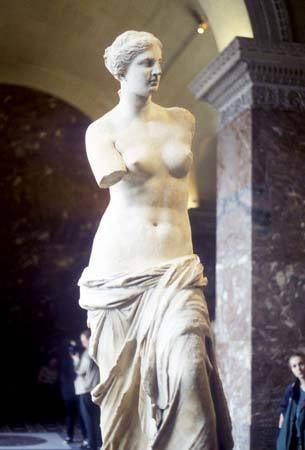
(12,799 posts)It is both beautiful and eloquent. And religious, as was this:
okasha
(11,573 posts)No Ebay, no art fairs, no trudging from gallery to gallery with your portfolio hoping for a dealer to represent you for a 40% cut of the take. Some artists had regular clients. The ones who couldn't find steady work ended up like Caravaggio. The lucky ones, like Michelangelo, had employers. His was the Pope.
LiberalAndProud
(12,799 posts)The de Medici chapter of the papal history might be illustrative of the alignment of the power of wealth with the power of the Church, and that can get rather sticky.
Still, wherever the money came from in this case, Michelangelo was brilliant.
okasha
(11,573 posts)The Medici furnished a pair of Popes, after all, who duly had themselves painted. Leo X's portrait by Raphael also shows his cousin Giulio, who was to become Clement VII. Michelangelo didn't come cheap, either.
BTW, are you familiar with the Rondanini Pieta? It's unfinished--Michelangelo was working on it at the time of his death--and to my eye, at least, more beautiful and poignant than the Vatican masterpiece. (My phone can't handle an image, but a picture of it. should be available on line.)
LiberalAndProud
(12,799 posts)But The Pietà speaks to me. Eye of the beholder and all that.
okasha
(11,573 posts)The Vatican Pieta is incredibly beautiful and moving. No disparagement of it in any way intended. It's technically brilliant, too, even more so than the David.

deathrind
(1,786 posts)It has brought more bad than good.
Yorktown
(2,884 posts)Please be specific.
deathrind
(1,786 posts)Other than its unique and fantastic story.
The human traits for both good and bad behaviors as well as our ability to hold a conviction in a belief existed long before the beginning of today's 3 major religions.
Maedhros
(10,007 posts)but one must be truly ignorant not to recognize how religion has shaped our civilization, in both good and bad ways.
What a garbage OP.
Yorktown
(2,884 posts)That is the contention of the OP.
Please bring proof disproving that contention.
Only then will you have earned the right to call it garbage.

LuvLoogie
(8,980 posts)Social/familial congregation and union, a fount of artistic inspiration, from musical requiems,masses, carols and choruses,
Frescos, tapestries,canvas and sculpture.
Religion frames many of mankinds failures, but it also frames many of its great works. The fault lies in our selves.
Yorktown
(2,884 posts)Nice.
Still a far way from a guide to human morality.
LuvLoogie
(8,980 posts)But that's not all it does. A Religion has many components. Rites, tenets, teachings, beliefs, mantras that focus mind and intent. Men have the potential for good and evil within any social framework. Take the areligious Wall Street or MIC.
Like it or not. Religion frames, motivates, is integral to many cultures throughout history. And yes it has been a moral guide.
Your problem is with the morality of individuals.
Take the U.S. Constituion as a social or moral guide. Might as well shit all over people's trust in that as well.

customerserviceguy
(25,406 posts)brought something to the societies that espoused them, or they would not have survived. My guess is that it produced better commitment to warmongering. When you can get people to do something for an unprovable, thus irrefutable, 'afterlife' as opposed to having the best possible here-and-now life, then you can create conquerors.
Yorktown
(2,884 posts)Kings and Cheiks said it themselves.
Arugula Latte
(50,566 posts)for various gains.

Act_of_Reparation
(9,116 posts)It isn't that religion has never done anything good for mankind. It certainly has, be it directly or otherwise. It has played a major role in the arts, scholasticism, diplomacy, and philosophy throughout the ages.
My opinion on the matter, however, is that secularism can do the same things without the negative consequences inherent to religious belief.
Yorktown
(2,884 posts)When you say
religion brought nothing to the fields you mention
• Arts are crafts. They are techniques. Then some artists bring in mastery, talent.
Religion is not providing anything to those crafts, techniques, talents.
Religion only provided themes. Like other legends. I like Botticelli's Birth of Venus myself.
• Diplomacy is a settling of human affairs. No religion involved (other than an excuse)
• Philosophy existed before baby Jesus and warlord muhamad. And will survive them.
• As for scholasticism, I would venture that religion by definition opposes it.
Scholasticism relies on critical analysis of everything under the sun.
Religions are not to keen on critical analysis of themselves.
But you do agree that religions bring ill by themselves
Back to my initial question:
what demonstrable good did religions bring other than a placebo effect?
(placebo effect which my OP concedes had a positive effect for primitive societies)
About 150 posts as of now, and not one single demonstrably inherent good of religion..

LostOne4Ever
(9,768 posts)[font style="font-family:'Georgia','Baskerville Old Face','Helvetica',fantasy;" size=4 color=teal]It is an expression of imagination and creativity. This goes beyond just making pots and painting techniques but goes into story telling.
Religion unquestionably has greatly impacted these areas. Countless works of song and fiction, especially in the fantasy genre, are directly based upon religion and hold it as a major theme.
Stories of gods and goddesses, Minotaur and unicorns, fairies and behemoths are taken directly from a variety of religions. Of course, it only natural that religion should influence these things. Fictitious stories has a long history of influencing other fictitious stories.
Religion is no different [/font]
Yorktown
(2,884 posts)Fairies too were an Art theme. And fairies never brought anything tangible to mankind.
This is why I ask if religions ever brought anything positive besides a placebo effect.
LostOne4Ever
(9,768 posts)Last edited Sat Mar 28, 2015, 05:28 AM - Edit history (1)
[center] [/center]
Yorktown
(2,884 posts)Sad, isn't it?
LiberalAndProud
(12,799 posts)That probably isn't a positive contribution any more than the Spanish Inquisition, which we can blame on religion as well.
Oh, you were asking for positive contributions.
Russell Betrand identified two of those.
http://www.positiveatheism.org/hist/russell2.htm
Yorktown
(2,884 posts)Astronomy existed in China before Jesus and Pope Gregory.
The fact that astronomy had a temporary lead in Christian societies is irrelevant.
As is the fact maths had a temporary lead in Ancient Greece or XIth Century muslim world.
LiberalAndProud
(12,799 posts)Won't even give Egyptian priests any credit.
Okay. I'm fresh out. Done. Defeated. Carry on.
LTX
(1,020 posts)Which societies did not invent gods?
LTX
(1,020 posts)(murder, theft, rape) or abuse (drugs, alcohol). Not one of them found a positive correlation between belief and lower crime or abuse (there is even a slight correlation the wrong way)."
Not one? Which studies are you referring to, and are you saying that the following studies drew erroneous conclusions and should be disregarded?
"Religion and Crime Reexamined: The Impact of Religion, Secular Controls, and Social Ecology on Adult Criminality," Criminology (March 7, 2006). http://onlinelibrary.wiley.com/doi/10.1111/j.1745-9125.1995.tb01176.x/abstract
Abstract: "Since Hirschi and Stark's (1969) surprising failure to find religious (“hellfire”) effects on delinquency, subsequent research has generally revealed an inverse relationship between religiosity and various forms of deviance, delinquency, and crime. The complexity of the relationship and conditions under which it holds, however, continue to be debated. Although a few researchers have found that religion's influence is noncontingent, most have found support—especially among youths—for effects that vary by denomination, type of offense, and social and/or religious context. More recently the relationship has been reported as spurious when relevant secular controls are included. Our research attempts to resolve these issues by testing the religion-crime relationship in models with a comprehensive crime measure and three separate dimensions of religiosity. We also control for secular constraints, religious networks, and social ecology. We found that, among our religiosity measures, participation in religious activities was a persistent and noncontingent inhibiter of adult crime."
"'If You Love Me, Keep My Commandments': A Meta-Analysis of the Effect of Religion on Crime," Journal of Research in Crime & Delinquency (2013). http://jrc.sagepub.com/content/38/1/3.short
Abstract: "Do religious beliefs and behaviors deter criminal behavior? The existing evidence surrounding the effect of religion on crime is varied, contested, and inconclusive, and currently no persuasive answer exists as to the empirical relationship between religion and crime. In this article, the authors address this controversial issue with a meta-analysis of 60 previous studies based on two questions: (1) What is the direction and magnitude of the effect of religion on crime? (2) Why have previous studies varied in their estimation of this effect? The results of the meta-analysis show that religious beliefs and behaviors exert a moderate deterrent effect on individuals' criminal behavior. Furthermore, previous studies have systematically varied in their estimation of the religion-on-crime effect due to differences in both their conceptual and methodological approaches."
Chemisse
(31,402 posts)What if those who were less likely to be criminals (more moral, perhaps) were more likely to follow religion?
LTX
(1,020 posts)The studies only demonstrate correlation, not causation (and they were cited merely as a refutation of the OP's "no correlation" assertion). There is the distinct possibility (some would say probability) that moral imperatives gravitate towards moral confirmations, which in your posited case would be religiously-based moral precepts.
LiberalAndProud
(12,799 posts)I'm speaking of either position that religion does or does not deter bad behavior.
Anecdotally, I think we all know of individuals who's religious conviction compels them to do good. Things that we all agree are good. On the other hand, the man who murdered Dr. Tiller felt compelled by his religious convictions to do something that I find reprehensible. As impartial as the studies try to be, I can't find that they speak to the question at hand with any degree of authority.
I will acknowledge and agree with your point that the OP makes a sweeping generalization that you have proven to be untrue.
LTX
(1,020 posts)The problem when dealing with religious belief is that it is a purely subjective phenomena, making any causation study inherently suspect. But then, moral agreement in a population is itself a purely subjective phenomena, measurable only by numbers in consensus and correlation between accepted precepts and (tautologically) compliance with those accepted moral precepts.
LiberalAndProud
(12,799 posts)It simply gets too theoretical and high-minded for my puny intellect. Surely we can agree that developing social mores (let us not talk morality) is a process, an often painful dialogue. I hope, as Dr. King posited, that the arc is toward justice.
Yorktown
(2,884 posts)I stand corrected, you did produce studies claiming a negative correlation between religiosity and criminality.
Alas, it is far from enough to demonstrate that religion produces more good than evil from a demonstrable measurement of violence:
1- because of the studies proving the reverse or no religion/crime correlation
reverse correlation
* Gregory S. Paul (2005) argued for a positive correlation between the degree of public religiosity in a society and certain measures of dysfunction (in Journal of Religion and Society)
* Phil Zuckerman (2008) "the least religious countries in the world, and possibly in the history of the world", enjoy "among the lowest violent crime rates in the world [and] the lowest levels of corruption in the world". (in Society without God)
* UC Berkeley (2012) non-religious people had higher scores showing that they were more inclined to show generosity in random acts of kindness (Social Psychological and Personality Science Journal)
no correlation
* your abstract quotes Hirschi and Stark's (1969) failure to find religious effects on delinquency
* Brent Benda (1997) concluded that there were no statistically significant negative correlations between religiosity and crime http://jrc.sagepub.com/content/34/2/163
* Phil Zuckerman (2009) not enough data to indicate any correlation between religiosity, secularism, and crime. http://www.pitzer.edu/academics/faculty/zuckerman/Zuckerman_on_Atheism.pdf
2- Because religion negates certain crimes are such
In the studies above, only crimes universally accepted as crimes or substance abuse are counted. Straightforward enough: crimes per inhabitant, grams of pure alcohol, etc.
How about other 'crimes' invented by religion? How many homosexuals stoned to death or hanged? Honor killings? Are you aware that under Sharia Law, it is NOT a crime to kill someone for apostasy? Such murders do happen and never make it in the statistics. Better still, rejecting such crimes is only a minority view in largely populated countries
3- Then, in memoriam, you have all the killings in the conquests of conversion
In Europe, it lasted for about one millenium, form the Franks to the 30 years war.
In Islam, about as long, from muhamad to Vienna II. And it's restarting.
But I will do penance. My wording was loose. I think people of good 'faith' could settle on:
No conclusive link between religion and morality can be demonstrated
(and that's being nice, not counting the wars of religious conquest)
Therefore, back to my OP question: what demonstable good did religion bring to the world?
LTX
(1,020 posts)and this helped quell the fears of the population. It had an evolutionary benefit in that it helped societies relieve their angst."
As Pascal Boyer pointed out, this particular view is just one sub-part among the just-so bromides used to account for the origins of religion, which can generally be summarized as falling into one of the following categories: religion provides explanation; religion provides comfort; religion provides social order; religion is a cognitive illusion. They are not without some merit, but they each fall prey to contradiction in the widely variable anthropological arena of actual religious practices and adherents.
Yorktown
(2,884 posts)Comfort, yes (placebo)
Social order, not really (it's just claiming the secular right of Law & Order)
I do not understand the nuance between explanation and cognitive illusion?
Yorktown
(2,884 posts)I haz a sad.
I was hoping to learn what religions had contributed.

stone space
(6,498 posts)
Yorktown
(2,884 posts)I tried to Google your plowshares and didn't find.
Can you give me a link to a text?

jonno99
(2,620 posts)Nope - sorry. I don't buy it...
AtheistCrusader
(33,982 posts)recorded human history. Bit of a bloody-minded horror now. Used as a weapon, more often than not.
LTX
(1,020 posts)You had me going too, until you pulled your grinding wheel out of the closet.

thucythucy
(9,160 posts)of Paradise Lost, and the activism of the Rev. Dr. Martin Luther King Jr., the White Rose, and the proponents of Liberation Theology, among many others.
Not necessarily listed in order of merit or importance.
Yorktown
(2,884 posts)Liberation Theology is just blending in religion into liberation movements.
thucythucy
(9,160 posts)often religious, and not Marxist.
When, for instance, Marxists all over the world adapted the official party line in 1939 that the German-Soviet Pact was a great thing, and that opposition to Hitler was simply another aspect of "imperialism," religious opponents of the regime were not swayed.
And to say liberation theology is "just blending in religion" is rather superficial. In fact, it might be more accurate to say it's "just blending" Marxist analysis into Christian theology.
Either way, it was definitely a contribution, as it helped in the overthrow of Somoza, undermined the Pinochet junta, and was considered such a threat by the Salvadoran death squads that they felt compelled to assassinate Bishop Romero in public, while he was delivering Mass.
Consider also that the struggle against British imperialism in India, and racist segregation in the US, were led in large part by religious leaders and organizations--Mahatma Gandhi ("Mahatma" is a religious appellation meaning "Great Soul" and the Rev. Dr. Martin Luther King Jr. and the Southern Christian Leadership Conference in the US. The first major organized effort against racial oppression in South Africa was the Satyagraha campaign, also organized by Gandhi and his associates. "Satyagraha" roughly means "soul power"--one can hardly have "soul power" without some concept of a "soul."
The current resistance to Chinese imperialism in Tibet is hardly Marxist, since it is Marxists doing the oppressing. The resistance is centered around the person of the Dalai Lama, who is, of course, primarily a spiritual leader. The opposition to the oppressive oligarchy in the former German Democratic Republic, where again the oppression was instigated and perpetuated by Marxists, was centered in the Lutheran churches--I visited one of the centers of the resistance in Leipzig, where the Stasi made efforts to infiltrate religious groups and would routinely monitor church meetings and worship.
You didn't address the cultural/artistic contributions, which I take it you accept without question. Have you ever read the opening of "Paradise Lost"? Among the most beautiful lines of poetry in the English language. Bach's music is almost entirely religious. Raphael's paintings likewise. Even an artist as secular as George Groscz used religious imagery to make his point--his famous sketch of the crucified Christ wearing a gas mask, as one of his many attacks on German militarism in World War I, and war in general.
You asked "what has religion contributed" and I answered. To dismiss all religion, or more to my point all people whose actions, art, and progressive politics have been rooted in spirituality is to dismiss an enormous part of human history and experience. I can be as critical of religion as almost anyone, but I don't shut my mind to all that it has contributed and all that it means to very many progressive and good people I know. To condemn all religion is to surrender the spiritual realm to the reactionaries. It's analogous to allowing conservatives to claim that they're "the real Americans" and the rest of us not. It alienates progressive groups such as the United Church of Christ, the American Friends, the Glide congregation, the Catholic Workers, and the MCC. The MCC--just as one example-were fighting for LGBT rights decades ago, when Marxists all over the world were condemning gay people and gay life as "capitalist perversions." It was Marxists, BTW, who arrested Allen Ginsberg in Prague.
It doesn't make sense factually, or politically, to lump all spirituality and all spiritual people in with the bigoted reactionaries. Don't you agree?
Best wishes.
Yorktown
(2,884 posts)• Art: I had skipped that because I had discussed it with others. But it's true it's a long thread.
The reason I say religion in itself did not contribute to Art is that Art exists with or without religion. Greek statuary did not need Jesus. The Birth of Venus is a beautiful painting irrespective of the reality of the existence of Venus. Cain and Abel doesn't need to be religious, it's the fight of the strong vs the weak. And the best Requiem was composed in honor of atheistic masonic values by Mozart.
• Religion theology to me is a good example that religion was just pasted on one side. If only because in most South American countries, the religious hierarchy sided with whichever strongman was in power. So you could have priests on both sides of the different south american conflicts. Which tends to show religion was not bringing any inherent morality to conflicts, its preachers being split.
• Ghandi/Hinduism: the issue is too confused to call. As Hindu intolerance demonstrated often in recent times, the religion is difficultly separable of a fierce Indian nationalism. I dare venture that for the common man in India in the 40s, the aspiration was primarily that of a nationalistic independence. The culture with its religious undercurrent did color the way the road to independence happened, but the process can't be strictly linked to religion.
• Tibet/China: there are different way to be wrong, they do not all follow the religious or not dimension. Chinese authorities are up for a land grab in the name of selfish national interest (and not atheism). But the Tibetan buddhist clique was a bunch of obscurantist leeches. so, in that conflict, it's difficult to see a positive role played by either atheism or religiosity.
Anyway, all in all, I would grant religion did play a role (1) as a consoling placebo and (2) as a vehicle to get complicated messages accepted (like the interdiction of eating pork/trichinosis) in primitive societies.
But I would also say that the key messages of religion are fantasies (hell, paradise, god, soul, miracles) and do not bring anything tangible to mankind today.
thucythucy
(9,160 posts)Art exists without religion: very difficult to know which came first. The cave paintings which are humanity's oldest surviving artistic expression would seem to come out of some religious impulse--the idea being that drawing (or naming) an animal will in some way place it under the influence of the artist being a common feature of early religious thought. Difficult to see, otherwise, why people, consumed with the struggle to survive, would take long hikes deep into the interior of a cave to craft art that will not be seen except by torch light, and can serve no practical (i.e. non-religious or non-magical purpose) whatsoever.
If that is the case, then one could say that all art (and music as well, since the first instances of musical expression were basically hymns--the first Greek drama, for instance, occurred in the context of ritual) came out of religion. A pretty major contribution, I'd say, one that continues today.
Liberation theology. As far as I can tell, it was religious people who crafted/came up with Liberation Theology. Many of the early Sandinistas, for instance, were Catholic priests (who were of course censured by Pope JPII for their affiliations to Marxists). It was the moral authority of Liberation Theology--which claimed to be a more true reading of the Gospels--which enlisted so much support from the masses, certainly in Central America. It is true, however, that the hierarchy of the Catholic Church has historically sided with the elites, which is one reason why Liberation theology was seen as so, well, liberating.
I can't be certain what "the common man" in India of the '20s, '30s and '40s was thinking, but Gandhi himself, who is widely regarded as among the most influential of Indian nationalist leaders, clearly saw himself as a person of faith. Read his autobiography, "My Experiments with Truth." One reason, I would venture to state, he was followed and was so influential was that he was seen as a spiritual man--"Mahatma." Similarly, the Rev. Dr. King Jr. held a high standing in the African American community, especially in the first days of the bus boycott, because he was a minister. No other title would have enabled such a young, and unknown man to assume such a position of leadership. (And King, BTW, was heavily influenced by the writings of another religious man--Reinhold Niebuhr, author of "Moral Man, Immoral Society" . The Rev. Jessie Jackson, Rev. Fred Shuttlesworth, Rev. Ralph Albernathy, etc, etc., all were obviously ministers. Malcolm X, similarly, was a person of faith who exerted tremendous influence on the liberation struggles of the '60s and thereafter.
China/Tibet. Interesting how, when a cabal of self-avowed Marxists (and atheists) commit mass crimes verging on genocide, this is being done not as a natural outgrowth of Marxism or atheism, but "as a land grab for selfish national interest." Whereas, when self-avowed Christians, say, or some part of a Christian hierarchy commit similar crimes, these are obviously and inextricably linked with their faith. If the subjugation of Tibet, which is billed by the Chinese militarists as a "liberation" from the shackles of oppressive religion by the enlightened proponents of dialectic materialism, can be seen instead as a thinly veiled land-grab (which I think is correct), why can't the brutal campaigns of aggression by the Spanish Conquistadors be seen in the same way? In the one, an atheist ideology--Marxism--is used to justify and conceal an imperialist grab. In the other, it's theist Catholicism. Judging by your own argument, the fact that theism and atheism are present in both instances would seem to eliminate them as prime movers in either case. You think, if the Spaniards had been Marxists instead of Catholics, they wouldn't have acted to subjugate South and Central America? You think if the current Chinese elites weren't Marxists, they still wouldn't be occupying Tibet?
And I wouldn't underestimate the power or importance of a "consoling placebo" that has enabled billions of people--who would have been oppressed and miserable in any case--to live out their lives with a greater sense of purpose, endurance, and dignity. Nor would I under-value the importance of essentially religious reforms among early cultures, as far as hygiene is concerned. Various legal reforms were also religious based. "Lex Talonis" for instance--the notion of "an eye for an eye and a tooth for a tooth." Today that's seen as barbarism--and it is--but introduced in cultures where a child could have his hands hacked off for stealing a loaf of bread (which was a Roman law at the time of Caligula and Claudius) the notion of a punishment proportionate to the crime was little short of revolutionary.
We'll have to agree to disagree, which is fine by me. But you asked the question, and so I'm giving you my answers.
Best wishes.