Welcome to DU!
The truly grassroots left-of-center political community where regular people, not algorithms, drive the discussions and set the standards.
Join the community:
Create a free account
Support DU (and get rid of ads!):
Become a Star Member
Latest Breaking News
Editorials & Other Articles
General Discussion
The DU Lounge
All Forums
Issue Forums
Culture Forums
Alliance Forums
Region Forums
Support Forums
Help & Search
General Discussion
Showing Original Post only (View all)
I'm going to post a chart you've seen a million times before (the myth of wage stagnation) [View all]
Last edited Mon Jul 20, 2015, 11:56 PM - Edit history (1)

We've all seen this. We've all noted the year in question, 1972 or so, and come up with various theories about what happened then to cause the decoupling.
Now look at another chart:
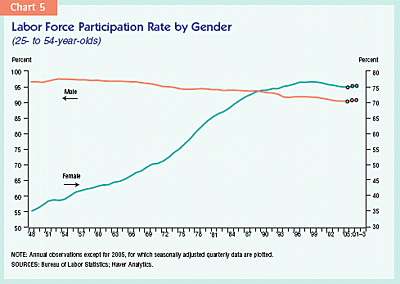
And I don't have pretty charts for the next bit, so you'll have to go to the census website here, and look at three spreadsheets:
Table P-36. Full-Time, Year-Round Workers by Median Income and Sex White
Table P-36. Full-Time, Year-Round Workers by Median Income and Sex Black
Table P-1. Total CPS Population and Per Capita Income Black
Now look at what that tells you (all dollar figures below are 2013 dollars):
In 1972, the median white male income was $54,368 and in 2013 it was $51,535, a decrease of 5%. The white male workforce increased from 36 million to 50 million in that period (39% increase), or from 17% of the population to 15% of the population.
In 1972, the median white female income was $30,734 and in 2013 it was $41,262, an increase of 34%. The white female workforce increased from 7 million to 41 million in that period (485% increase), or from 3% of the population to 13% of the population.
In 1972, the median black male income was $36,715 and in 2013 it was $41,555 (the highest it had ever been), an increase of 14%. The black male workforce increased from 3 million to 6 million in that period (100% increase), or from 1% of the population to 2% of the population.
In 1972, the median black female income was $26,292 and in 2013 it was $35,460, an increase of 35%. The black female workforce increased from 2 million to 6.7 million (235% increase), or from 1% of the population to 2% of the population.
 .
.Lumberjack_jeff is right, and I was reading those wrong, sorry. The gains for women and minorities from 1955 to 1972 were similar to their gains from 1972 to 2013. The real jumps there seem to have been over the course of the 1960s (which also undercuts the idea that the workforce expanded in response to decreasing wages rather than the other way around). But the stagnation still has only hit white males, and women and minorities still have a lot of wage catching-up to do.
The narrative of stagnant wages is strictly a narrative of the white male subsection of the country. The narrative of a shared prosperity in the period before the Great Decoupling is a narrative of the white male subsection of the country. Those higher wages could be paid to white men in the 1950s and 1960s because they were not being paid to women and minorities.
This isn't the fault of marginal tax rates (though we should raise the wealthiest for budgetary and incentive reasons). This isn't the fault of trade (though we should buy less crap from China and India). The narrative of economic stagnation over the past 40 years is precisely the complaint of white men who have for the first time in the nation's history had to share economic growth with other groups. We still don't have shared prosperity (female median income is 80% of male median income; black median income is 72% of white median income), but we are closer to it now than we were before the alleged stagnation.
The past rarely was as it is remembered, and this is an important example of that. If I'm skeptical of old solutions it's because I'm looking at their track record. I don't think we know what a genuinely shared prosperity in the US would look like because it hasn't happened yet, and if we need a New New Deal to get there, it's going to have to be so fundamentally and structurally different than the original one, to avoid the great disparities listed above, as to be nearly unrecognizable.
122 replies
 = new reply since forum marked as read
Highlight:
NoneDon't highlight anything
5 newestHighlight 5 most recent replies
= new reply since forum marked as read
Highlight:
NoneDon't highlight anything
5 newestHighlight 5 most recent replies
= new reply since forum marked as read
Highlight:
NoneDon't highlight anything
5 newestHighlight 5 most recent replies
I'm going to post a chart you've seen a million times before (the myth of wage stagnation) [View all]
Recursion
Jul 2015
OP
LOL. "Before the early 1970s, the only group that was seeing their income increase was white males"
PSPS
Jul 2015
#1
And women who worked as a housekeeper part time weren't counted in wage surveys
Recursion
Jul 2015
#4
Absolutely. And teachers (the career track for girls too upscale to be "just secretaries" ) ...
hedda_foil
Jul 2015
#6
And the average house was a lot smaller, had fewer bedrooms and bathrooms. And many families
raccoon
Jul 2015
#78
Which leads to the conclusion that a single earner could support a family today
Recursion
Jul 2015
#87
Thanks. The "aww, poor, whiny white guys" angle isn't an answer to the obvious wage problem. n/t
Beartracks
Jul 2015
#66
Socialism (in the real Marx sense) is probably the best way to do a universal income
Recursion
Jul 2015
#104
No, people just make a lot of assumptions about me. I've posted more about minimum income than trade
Recursion
Jul 2015
#109
I live and work in a city where 10,000 people die from waterborne illnesses every year
Recursion
Jul 2015
#114
I can see that. But even those gains have been below what they SHOULD have been.
Beartracks
Jul 2015
#119
Thanks. I don't need to look at any charts to know the OP is bullshit. I live in 2015 reality and I
GoneFishin
Jul 2015
#111
It's insulting for Democrats to have this RW trash pushed on us day after day. nt
Zorra
Jul 2015
#80
It's always helpful to know where you are coming from. If you worked an hourly labor job
B Calm
Jul 2015
#15
The average UNIX administrator salary is $92,000, do you think that's what hourly employees
B Calm
Jul 2015
#20
Looks like hourly compensation stagnated particularly from the mid-70's to the mid-90's,
pampango
Jul 2015
#21
I'm curious how that can be since real median income for men is higher now than say 1960
Recursion
Jul 2015
#28
There are, I think, many factors such as declines in pensions for 401 K's and such for an example.
mmonk
Jul 2015
#34
Also, the greater the income gap between the richest and the typical American family is,
mmonk
Jul 2015
#36
The 20:20 ratio is a much better way to determine the effects of income inequality in terms of
mmonk
Jul 2015
#45
So? At best this shows a time old employer tactic: "bring in cheaper workers"
Tom Rinaldo
Jul 2015
#30
Interesting perspective. So is the denominator in first graph total paid working hours?
lostnfound
Jul 2015
#35
It would be hard to argue that expanding the labor pool didn't push wages down
Recursion
Jul 2015
#39
I just think that supporting the fabulously wealthy Corporate-backed candidate is the solution...
Romulox
Jul 2015
#59
I'm glad you know the names of several cities in Michigan, but this is all a bit random.
Romulox
Jul 2015
#70
What were you proposing I rebut? I missed your point, except you object to my presence.
Starry Messenger
Jul 2015
#71
Pretty much-- along with the standard divide and conquer appeal to identity politics and
Marr
Jul 2015
#89
Might also have to do with white men monopolizing "skilled" work for much of America's history
YoungDemCA
Jul 2015
#67
No, I'm not assuming that. I'm assuming white men held a monopoly on higher paying fields
Recursion
Jul 2015
#84
OH good. You've taken up with the Troy University set with this latest hilarity.
HughBeaumont
Jul 2015
#83