Welcome to DU!
The truly grassroots left-of-center political community where regular people, not algorithms, drive the discussions and set the standards.
Join the community:
Create a free account
Support DU (and get rid of ads!):
Become a Star Member
Latest Breaking News
Editorials & Other Articles
General Discussion
The DU Lounge
All Forums
Issue Forums
Culture Forums
Alliance Forums
Region Forums
Support Forums
Help & Search
Economy
In reply to the discussion: Weekend Economists Kickoff the Season, September 6-8, 2013 [View all]Demeter
(85,373 posts)11. Look at the economy to see why today’s jobs report is so important!
http://fabiusmaximus.com/2013/09/06/economy-boom-54699/
...On September 17-18 the Federal Reserve Open Market Committee will meet to decide if they should begin the “taper” — the slow withdrawal of monetary stimulus begun with the first rate cut on September 2007. Much depends on their decision. The Fed’s announcement that the taper is coming has doubled the ten year treasury rate — now slightly below the 3% level at which severe disruptions are likely. This interest rate rise is affecting US industries, seen in trend in housing starts and purchase mortgage applications — and disrupted money flows which have destabilized many emerging nations. That’s just from announcement of the taper. The actual event will produce even larger waves. Especially with the state of the economy so uncertain.
How’s the economy doing?
Although most economists expect a continuation of the acceleration of growth from the near-standstill of Q4 2012 — which warrants the withdrawal of the monetary and fiscal stimulus programs — the economic data does not show it. So far there are few signs of the sustainable acceleration of growth that so many have seen soon ahead for so long. Fed tapering could turn ugly with energy prices high, the sequester’s effects still being felt, and rates rising fast. Who can say for certain? Most surveys of people show growing confidence: surveys of builders, of consumers (Conference Board, Michigan Survey), and especially of purchasing managers. But the actual economic data is less exciting. Almost all show either continued slow growth or slowing growth. For results from a wide range of indicators see Status report on the US economy. Here are a few of special interest. Start with the Big Four, looking anemic in July and August:

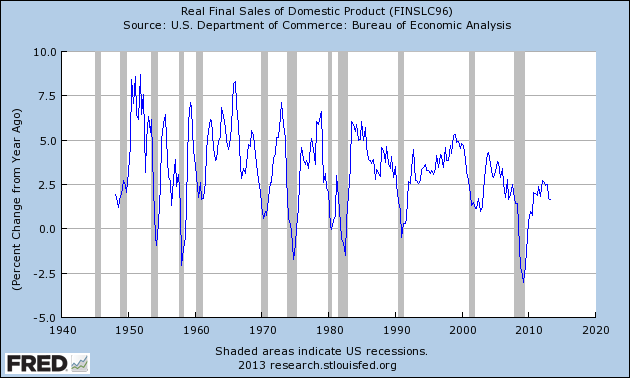
Another important indicator: YoY percent change in real final sales of domestic product. At +1.6% in Q2, this was at a level only associated with recessions excerpt for one occasion: an oddball print of +1.3% in Q3 of 1956.
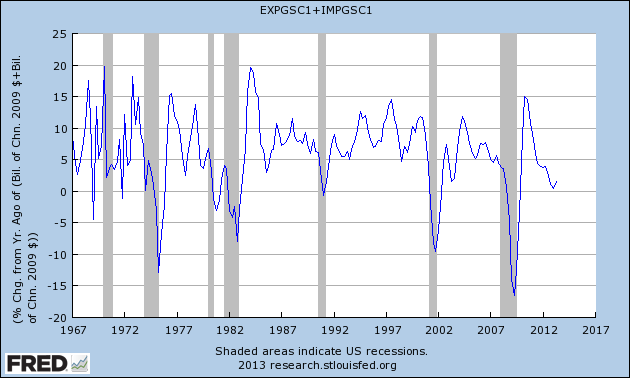
Another dark picture: YoY percent change in real trade of goods and services (imports plus exports). Also at a level seen only before or in recessions, except for Q4 of 1972.
SUPPORTING LINKS AND COMMENTARY FOLLOWS
...On September 17-18 the Federal Reserve Open Market Committee will meet to decide if they should begin the “taper” — the slow withdrawal of monetary stimulus begun with the first rate cut on September 2007. Much depends on their decision. The Fed’s announcement that the taper is coming has doubled the ten year treasury rate — now slightly below the 3% level at which severe disruptions are likely. This interest rate rise is affecting US industries, seen in trend in housing starts and purchase mortgage applications — and disrupted money flows which have destabilized many emerging nations. That’s just from announcement of the taper. The actual event will produce even larger waves. Especially with the state of the economy so uncertain.
How’s the economy doing?
Although most economists expect a continuation of the acceleration of growth from the near-standstill of Q4 2012 — which warrants the withdrawal of the monetary and fiscal stimulus programs — the economic data does not show it. So far there are few signs of the sustainable acceleration of growth that so many have seen soon ahead for so long. Fed tapering could turn ugly with energy prices high, the sequester’s effects still being felt, and rates rising fast. Who can say for certain? Most surveys of people show growing confidence: surveys of builders, of consumers (Conference Board, Michigan Survey), and especially of purchasing managers. But the actual economic data is less exciting. Almost all show either continued slow growth or slowing growth. For results from a wide range of indicators see Status report on the US economy. Here are a few of special interest. Start with the Big Four, looking anemic in July and August:
Another important indicator: YoY percent change in real final sales of domestic product. At +1.6% in Q2, this was at a level only associated with recessions excerpt for one occasion: an oddball print of +1.3% in Q3 of 1956.
Another dark picture: YoY percent change in real trade of goods and services (imports plus exports). Also at a level seen only before or in recessions, except for Q4 of 1972.
SUPPORTING LINKS AND COMMENTARY FOLLOWS
Edit history
Please sign in to view edit histories.
Recommendations
0 members have recommended this reply (displayed in chronological order):
62 replies
 = new reply since forum marked as read
Highlight:
NoneDon't highlight anything
5 newestHighlight 5 most recent replies
RecommendedHighlight replies with 5 or more recommendations
= new reply since forum marked as read
Highlight:
NoneDon't highlight anything
5 newestHighlight 5 most recent replies
RecommendedHighlight replies with 5 or more recommendations
= new reply since forum marked as read
Highlight:
NoneDon't highlight anything
5 newestHighlight 5 most recent replies
RecommendedHighlight replies with 5 or more recommendations
A weekend moment to reflect on the course of the course of the US economy. Not a pretty picture.
Demeter
Sep 2013
#33
Scarcity: Why Having Too Little Means So Much by Sendhil Mullainathan and Eldar Shafir – review
xchrom
Sep 2013
#37
Federal Reserve Has A Demographics Problem An Aging Society Is Making Monetary Policy Less Effective
xchrom
Sep 2013
#45
All Of The Financial Advice You're Ever Going To Need Is Written On This Index Card
jtuck004
Sep 2013
#47
Doomsteaddiner has 2 podcasts with Nicole Foss (Stoneleigh) of The Automatic Earth
DemReadingDU
Sep 2013
#53