Welcome to DU!
The truly grassroots left-of-center political community where regular people, not algorithms, drive the discussions and set the standards.
Join the community:
Create a free account
Support DU (and get rid of ads!):
Become a Star Member
Latest Breaking News
Editorials & Other Articles
General Discussion
The DU Lounge
All Forums
Issue Forums
Culture Forums
Alliance Forums
Region Forums
Support Forums
Help & Search
Economy
In reply to the discussion: Weekend Economists Kickoff the Season, September 6-8, 2013 [View all]Demeter
(85,373 posts)33. A weekend moment to reflect on the course of the course of the US economy. Not a pretty picture.
http://fabiusmaximus.com/2013/09/08/jobs-wages-economy-54753/
The monthly employment report provides the opportunity to look at the New America being built on the ruins of the own. While seldom remarked, it clearly appears in the data....
Better days are here, for some of us.
“Big industry constantly requires a reserve army of unemployed workers for times of overproduction. The main purpose of the bourgeois in relation to the worker is, of course, to have the commodity labour as cheaply as possible, which is only possible when the supply of this commodity is as large as possible in relation to the demand for it …”
— Marx (1847, unpublished work)
“Taking them as a whole, the general movements of wages are exclusively regulated by the expansion and contraction of the industrial reserve army …”
— Marx, Das Kapital (1867)
One of the goals of the FM website is too provide its readers with a different perspective on events. We do this by presenting information, reporting expert analysis, and the occasional prediction. Hopefully this helps you see our complex and changing world more clearly than relying solely on mainstream sources.
Looking at the economy shows how this works. For the past 3 years I have shown that the widespread claims that the recession had not ended were false. I predicted that forecasts of an imminent return to post-WW2 average growth were likewise false.
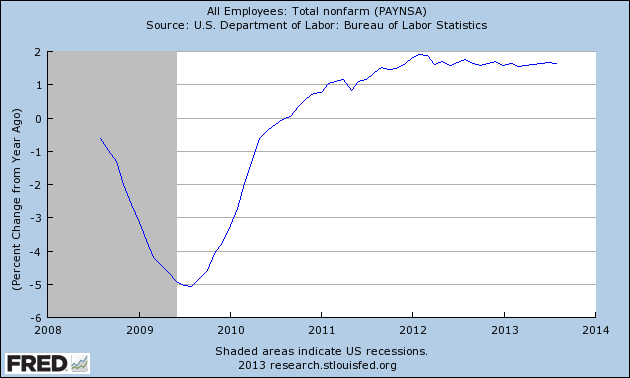
The monthly employment reports show this alternative perspective at work in another way. Each month brings a tide of forecasts. Boom! Bust! And analysis of the report is similarly dramatic. That’s how newspapers are sold and website traffic grows. It is, however, quite fallacious. Each month we duly and dully report that nothing has changed. Just more slow growth. As seen in this graph of monthly percent changes in the number of jobs (YoY, NSA). Steady, slow:
 ?w=900&h=540
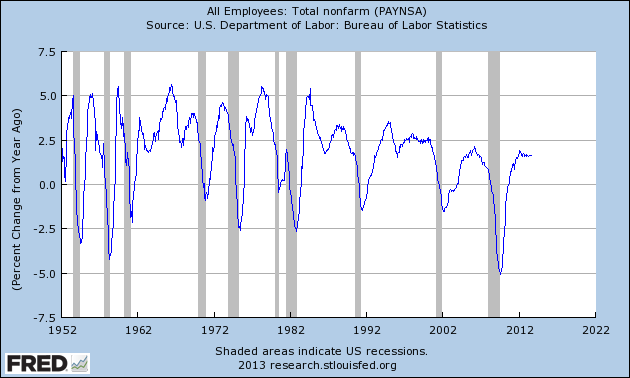
As usual, let’s put this in a longer-term context. Job growth has stabilized at an unusually low level. Also note how the business cycle was tamed after 1982. The magic ingredient: rapid debt growth. Being used today, but most aggressively by the Federal government. Without this fiscal stimulus we probably would look like Europe, and there would be fewer stories about America Ascendent.
 ?w=900&h=540
This is the big story. The breathless analysis monthly commentary in the media mostly discusses noise, which masks the important conclusion: at this rate the US will return to full employment in 4 or 5 years. Unfortunately the normal business cycle will likely give us another recession by then (we’re now in the 5th year of the expansion). But is this slow job growth a bug or a feature?
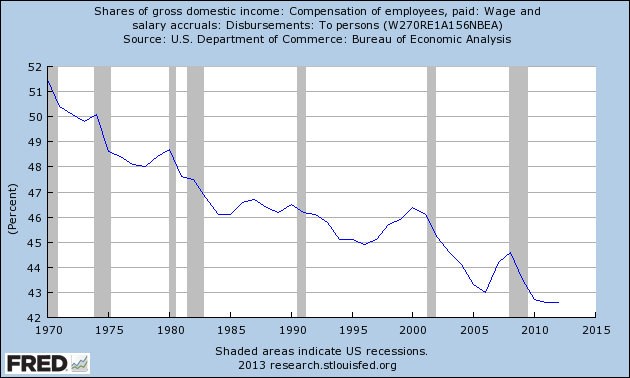
Marx was clearly wrong about the first wave of the industrial revolution. He might have the last laugh, however. Look at the trend in wages as a share of total domestic income (NSA).
 ?w=900&h=540
Crush unions, cuts taxes on business, fragment work into jobs that require minimal skills, fragment jobs into a largely part-time contingent workforce, expand training so that there is a surplus to demand, increase immigration, outsource work to other nations to create internal competition — and the profits will flow. This is the New America being built by large corporations from McDonald’s to Amazon.
Training too many skilled people is an important part of the game. Tight controls on the supply of doctors shows the effect of too-small supply. The relatively low wages of engineers and scientists shows how corporations run the supply-demand equation for their benefit: “The STEM Crisis Is a Myth“, Robert N. Charette, IEEE Spectrum, 30 August 2013 — “Forget the dire predictions of a looming shortfall of scientists, technologists, engineers, and mathematician.” A reliable formula for higher profits: training more than there are jobs AND import more workers from other nations.
The monthly employment report provides the opportunity to look at the New America being built on the ruins of the own. While seldom remarked, it clearly appears in the data....
Better days are here, for some of us.
“Big industry constantly requires a reserve army of unemployed workers for times of overproduction. The main purpose of the bourgeois in relation to the worker is, of course, to have the commodity labour as cheaply as possible, which is only possible when the supply of this commodity is as large as possible in relation to the demand for it …”
— Marx (1847, unpublished work)
“Taking them as a whole, the general movements of wages are exclusively regulated by the expansion and contraction of the industrial reserve army …”
— Marx, Das Kapital (1867)
One of the goals of the FM website is too provide its readers with a different perspective on events. We do this by presenting information, reporting expert analysis, and the occasional prediction. Hopefully this helps you see our complex and changing world more clearly than relying solely on mainstream sources.
Looking at the economy shows how this works. For the past 3 years I have shown that the widespread claims that the recession had not ended were false. I predicted that forecasts of an imminent return to post-WW2 average growth were likewise false.
The monthly employment reports show this alternative perspective at work in another way. Each month brings a tide of forecasts. Boom! Bust! And analysis of the report is similarly dramatic. That’s how newspapers are sold and website traffic grows. It is, however, quite fallacious. Each month we duly and dully report that nothing has changed. Just more slow growth. As seen in this graph of monthly percent changes in the number of jobs (YoY, NSA). Steady, slow:
?w=900&h=540
As usual, let’s put this in a longer-term context. Job growth has stabilized at an unusually low level. Also note how the business cycle was tamed after 1982. The magic ingredient: rapid debt growth. Being used today, but most aggressively by the Federal government. Without this fiscal stimulus we probably would look like Europe, and there would be fewer stories about America Ascendent.
?w=900&h=540
This is the big story. The breathless analysis monthly commentary in the media mostly discusses noise, which masks the important conclusion: at this rate the US will return to full employment in 4 or 5 years. Unfortunately the normal business cycle will likely give us another recession by then (we’re now in the 5th year of the expansion). But is this slow job growth a bug or a feature?
Marx was clearly wrong about the first wave of the industrial revolution. He might have the last laugh, however. Look at the trend in wages as a share of total domestic income (NSA).
?w=900&h=540
Crush unions, cuts taxes on business, fragment work into jobs that require minimal skills, fragment jobs into a largely part-time contingent workforce, expand training so that there is a surplus to demand, increase immigration, outsource work to other nations to create internal competition — and the profits will flow. This is the New America being built by large corporations from McDonald’s to Amazon.
Training too many skilled people is an important part of the game. Tight controls on the supply of doctors shows the effect of too-small supply. The relatively low wages of engineers and scientists shows how corporations run the supply-demand equation for their benefit: “The STEM Crisis Is a Myth“, Robert N. Charette, IEEE Spectrum, 30 August 2013 — “Forget the dire predictions of a looming shortfall of scientists, technologists, engineers, and mathematician.” A reliable formula for higher profits: training more than there are jobs AND import more workers from other nations.
Edit history
Please sign in to view edit histories.
Recommendations
0 members have recommended this reply (displayed in chronological order):
62 replies
 = new reply since forum marked as read
Highlight:
NoneDon't highlight anything
5 newestHighlight 5 most recent replies
RecommendedHighlight replies with 5 or more recommendations
= new reply since forum marked as read
Highlight:
NoneDon't highlight anything
5 newestHighlight 5 most recent replies
RecommendedHighlight replies with 5 or more recommendations
= new reply since forum marked as read
Highlight:
NoneDon't highlight anything
5 newestHighlight 5 most recent replies
RecommendedHighlight replies with 5 or more recommendations
A weekend moment to reflect on the course of the course of the US economy. Not a pretty picture.
Demeter
Sep 2013
#33
Scarcity: Why Having Too Little Means So Much by Sendhil Mullainathan and Eldar Shafir – review
xchrom
Sep 2013
#37
Federal Reserve Has A Demographics Problem An Aging Society Is Making Monetary Policy Less Effective
xchrom
Sep 2013
#45
All Of The Financial Advice You're Ever Going To Need Is Written On This Index Card
jtuck004
Sep 2013
#47
Doomsteaddiner has 2 podcasts with Nicole Foss (Stoneleigh) of The Automatic Earth
DemReadingDU
Sep 2013
#53