...it doesn't matter how efficient a battery or a car is if it is run on electricity, particularly if the electricity is generated from fossil fuels.
A thermodynamic shell game is a crime against humanity, and that doesn't even count the moral cost of mining crap for batteries and electric cars, which are mass intensive.
Now, I know that there are zero "I'm not an antinuke" antinukes who bother to read a scientific paper, but as I'm pronuclear I obviously have done my homework, in fact about the area in which I live, on the PJM grid, where antinukes have worked to make my electricity particularly dirty, even more dirty than dirty German electricity, which is over 1000% more dirty than French electricity if one checks the annual figures on the Electricity Map. (As of this writing, the German carbon intensity on an annual basis is 342 grams CO2/kWh, France's 31 grams CO2/kWh, PJM 418 grams CO2/kWh.)
I covered a paper written about the energy intensity of electric, hybrid, and internal combustion engine on my grid here:
A paper addressing the idea that electric cars are "green."
From that post, from a paper published a little over two years ago, Cleaning up while Changing Gears: The Role of Battery Design, Fossil Fuel Power Plants, and Vehicle Policy for Reducing Emissions in the Transition to Electric Vehicles Matthew Bruchon, Zihao Lance Chen, and Jeremy Michalek Environmental Science & Technology 2024 58 (8), 3787-3799, the following graphic, in which environmental destruction associated with batteries has been monetized:
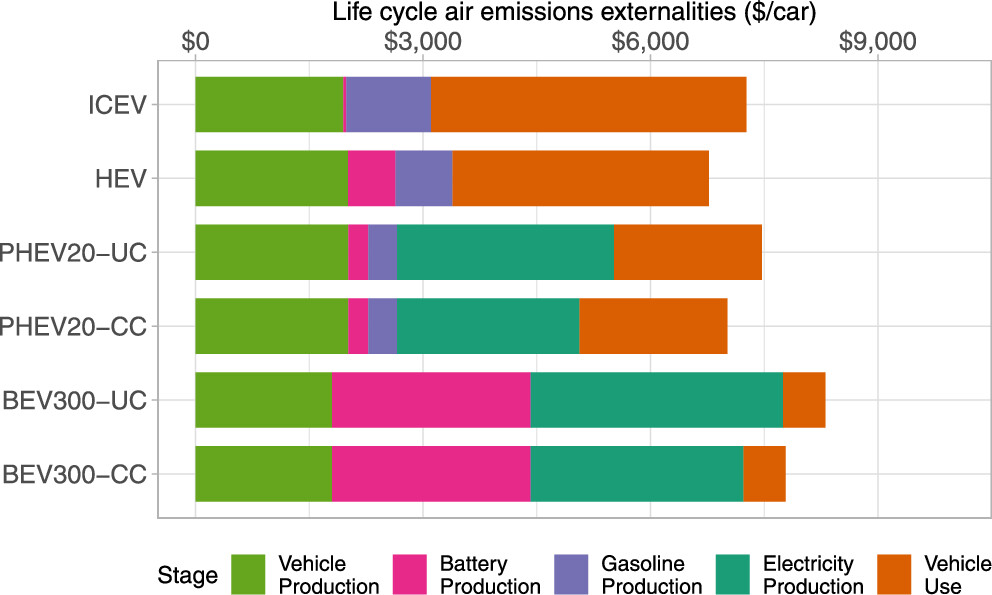
Figure 6. Consequential life cycle air emission externalities per vehicle in 2019, assuming 10% of the light-duty passenger car fleet in PJM’s service area is replaced with PEVs. “ICEV” denotes a conventional internal combustion engine vehicle, “HEV” denotes a standard gasoline hybrid electric vehicle (NiMH battery), “PHEV20” denotes a plug-in hybrid electric vehicle with a battery range of 20 miles (Li-ion battery with NMC111 cathode chemistry), and “BEV300” denotes a battery electric with a battery range of 300 miles (Li-ion battery with NMC622 cathode chemistry). “CC” indicates that battery charge schedules are optimally controlled by PJM to minimize system operation costs, and “UC” indicates that battery charging is uncontrolled (i.e., initiated by the vehicle owner as soon as they complete their daily driving and arrive home. “Production” includes disposal and recycling; “Vehicle Use” includes tailpipe emissions and tire and brake wear).
I drive a hybrid car, which on my grid, if one includes embodied energy - a subject about which apologists thermodynamic ignorance and obscene mineral mining couldn't care less - is
slightly better than an ICEV (Internal Combustion Engine Vehicle. My car is decidedly
not green, and there was no tax incentive to buy it; in fact at the time I bought it I paid a premium of about $7,000 more than I would have paid for an ICEV version of the car.
Of course, I'm not entirely bourgeois in the sense that I don't monetize the environmental destruction associated with the morally appalling apologetics with contempt for the laws of thermodynamics as battery apologists do. The fact that the battery industry has been described as
the dirtiest supply chain on Earth resonates with me and everything I know, since I have managed to avoid being scientifically illiterate and can say, at the end of my life, have made modest strides at trying to be more importantly
morally aware, although I am, at the end of the day, since I drive a
car, decidedly a bourgeois pig. I just don't caterwaul with mindless excuses for it.

 = new reply since forum marked as read