Welcome to DU! The truly grassroots left-of-center political community where regular people, not algorithms, drive the discussions and set the standards. Join the community: Create a free account Support DU (and get rid of ads!): Become a Star Member Latest Breaking News Editorials & Other Articles General Discussion The DU Lounge All Forums Issue Forums Culture Forums Alliance Forums Region Forums Support Forums Help & Search
 

GliderGuider

(21,088 posts)
17. As you say,
Wed Sep 25, 2013, 06:49 AM
Sep 2013
The question is how long will it take before CARBON is phased out; to that end we look at solar, wind, biomass, biomethane, geothermal and all types of hydro.

Given the performance in growing their coal industry and the now low and going lower cost of renewables, there is no reason to think that the rate of growth curve for renewables will not be at least as aggressive as that of coal.

In order to get a feel for that, let's look at China's build-out rate of carbon and non-carbon energy sectors. This graph shows the performance of both sectors over the last 12 years, since their big expansion began. The carbon line includes oil, gas and coal. The non-carbon line aggregates all renewables, hydro and nuclear power. Then the current trends are extrapolated out 6 years, based on these two assumptions of yours:

1. The growth curve of of renewables will be at least as aggressive as that for carbon energy. The curve chosen for renewables is a very aggressive 4th order polynomial, while the carbon trend shown is linear.

2. Change requires time. This implies that the policy decisions in place over the last 5 or ten years that are driving today's situation will remain in force for at least the next 6 years.
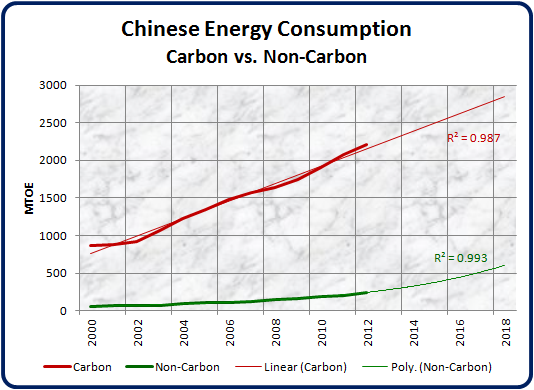


The 350 mtoe increase in renewables over the next 6 years represents the addition of between 2000 and 2500 GW of renewable capacity (with an average capacity factor of around 25% to factor in wind, hydro and solar).

Carbon-based energy, on the other hand, adds over 1000 mtoe in the same period - three times as much - under very pessimstic growth assumptions. (Note that as well as using a linear trend, I started in the year 2000, including the flat toe of the coal curve in the trend-line, thus flattening it further.)

So, based on your own assumptions, we may conclude that it will probably be longer than 6 years before current renewable build-out rates begin to take market share away from coal.

Of course, if China decides to sacrifice their own economic growth for the sake of the planet's climate by reducing their coal use, all bets are off. Let's pray that happens.

Recommendations

0 members have recommended this reply (displayed in chronological order):

Could you let me know what MToE means, please? OnlinePoker Sep 2013 #1
Million tonnes if oil Equivalent happyslug Sep 2013 #2
your list left off uranium quadrature Sep 2013 #16
Ask Wikipedia, where I obtain the list, I did include that cite happyslug Sep 2013 #21
Sure GliderGuider Sep 2013 #3
Equivelent to a million tons of oil. FBaggins Sep 2013 #4
Yes, I built the graphs myself, using the BP data which I've now linked in the OP. GliderGuider Sep 2013 #5
You left out the renewable discussion kristopher Sep 2013 #6
Just telling the current story. GliderGuider Sep 2013 #7
Hi kristopher, have a question for you, ... CRH Sep 2013 #8
According to BP, in 2012 China used a total of 2735.2 mtoe of primary energy GliderGuider Sep 2013 #10
Thanks Glider, I did some crude bashing of numbers myself, ... CRH Sep 2013 #12
The capacity factor of PV is variable, but 15% seems reasonable GliderGuider Sep 2013 #15
To make it more simple, ... CRH Sep 2013 #9
So how big a deal is 40 GW ... CRH Sep 2013 #11
Where are you wrong? Just about everywhere because you are looking in the wrong place and kristopher Sep 2013 #14
As you say, GliderGuider Sep 2013 #17
In relation to economic performance GliderGuider Sep 2013 #18
Reasons that outlook will probably change: cprise Sep 2013 #22
I like optimists: Their tears taste so nice after maturing for a couple of years. Nihil Sep 2013 #23
I was just pointing out the difference in mindset. n/t cprise Sep 2013 #24
Does a difference in mindset matter if the actions are the same? GliderGuider Sep 2013 #25
Give them a chance cprise Sep 2013 #26
Wait, what??? NickB79 Sep 2013 #27
It makes a lot of sense cprise Sep 2013 #28
Why do you insist on making false presentations of data? kristopher Sep 2013 #19
:-) GliderGuider Sep 2013 #20
Speaking of rate of build-out GliderGuider Sep 2013 #13
Latest Discussions»Issue Forums»Environment & Energy»Chinese consumption of co...»Reply #17